The USS Makin Island, an amphibious assault aircraft carrier, is an intimidating ship. Built by Northrup Grumman, Makin Island is 45,000 tons of cold steel and has living quarters for almost 3,200 sailors and Marines. Weighing in at a whopping 42,800 tons, the ship is 844 feet long and 106 feet wide. The vessel's 70,000 horsepower hybrid propulsion system enables Makin Island to reach speeds in excess of 20 knots.
A multi-purpose ship, Makin Island is designed to transport and land Marines via helicopter, landing craft or amphibious assault vehicle. In an impressive show of force, the Navy recently deployed Makin Island to South American waters. There, the ship made visits to several ports of call including the Brazilian city of Rio de Janeiro, the Chilean town of Valparaiso and the Peruvian capitol of Lima. More significantly, perhaps, the aircraft carrier could soon be deployed to the Central American country of Costa Rica.
If you just did a double take, that is understandable. For years, this small nation has prided itself on its adherence to pacifistic principles. In a region plagued by violence, Costa Rica historically managed to stay above the fray and the nation has not had an Army since 1949. The country, with a small population of just four million, is seen as safer than its Central American neighbors and an attractive destination for tourists and US retirees.
Costa Rica's Controversial Drug War
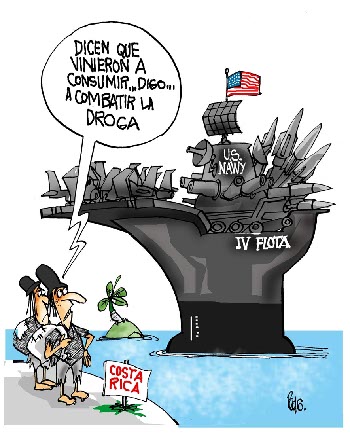
So, why is the Costa Rican government now inviting the US Navy to patrol its local waters? Officially, the Americans will be deployed to help stem the flow or drugs northward. The ships would arrive for at least six months to assist counternarcotics operations by Costa Rican officials. The government argues that the help is well needed. For some time, smugglers have used Costa Rica as a transshipment point for drugs coming from Colombia and Panama. Without any armed forces and with long coastlines and poorly guarded borders, Costa Rica is vulnerable to the machinations of technologically advanced drug cartels.
Indeed, Costa Rican authorities report that powerful Mexican cartels are infiltrating their country. Recently, local police seized more than a ton of cocaine at a house outside the capital and detained two Mexicans with alleged ties to the Juarez cartel. Meanwhile, the Costa Rican prison system has been put under enormous strain as the inmate population has soared. With a spike in drug-related crime, the prisons have spilled over and become more violent.
Prison crowding has been increased as a result of newly-elected President Laura Chinchilla's crime crackdown. Under her initiative, the government is set to double the police force and build more prisons. Even so, the government may be woefully unprepared to deal with the drug war. Costa Rica already receives millions of dollars in anti-drug aid from the US under the so-called Mérida Initiative, though Chinchilla recently met with Secretary of State Clinton to ask for yet more financial resources.
Moves to bring the US Navy to Costa Rica have sparked widespread suspicions that Washington is looking for a justification to remilitarize the Central American region. It's undeniable that a recent increase in violence has sparked panic. However, some have argued that the real issue has to do with the causes of violence. While the right argues that the spike has to do with drug cartels, the left believes that the violence has more to do with poverty and rising inequality. In Costa Rica, the gap between rich and poor has been widening dramatically in recent years. Consider that in the 1990s, the wealthiest 10 percent of Costa Rica's population made 15 times what the poorest tenth earned. However, in the 2000s, that figure was nearly 25 times.
Makin's Tour of Duty
Perhaps, Costa Rica's drug problem could be addressed through a combination of poverty alleviation and coastal interdiction. Indeed, for some time, Costa Rica has collaborated with the US Coast Guard. However, under the new arrangement, other branches of the American armed services are to be deployed. The US force which is called for is massive: a virtual flotilla of 46 warships accompanied by 7,000 Marines and five planes. Take a look at this footage of the USS Makin, and consider whether this huge aircraft carrier is best suited to combat drug trafficking or perhaps some other end. According to the Navy's own web site, the fearsome vessel "will also have secondary missions of sea control and power projection by helicopter and fixed-wing vertical short take-off and landing aircraft." The euphemism "power projection" caught my attention in this instance. To be sure, the cartels are a menace, but there is also an increasingly inflammatory geopolitical context to consider. In light of military developments in Costa Rica, it's perfectly reasonable to wonder whether the US might have some kind of ulterior agenda. Is it just a coincidence, for example, that Makin deployed to Brazil, a country which the US would surely like to employ as a counterweight to leftist Hugo Chávez in Venezuela? Consider also the vessel's port of call visits in Chile and Peru, two nations which have served as loyal US allies in a region which has recently undergone a leftward shift. For Venezuelans, it's an intimidating show of military force which, taken together with the deployment of the US Fourth Fleet in Caribbean waters, rattles the nerves. Central America: Balance of Power
Recently, I came upon an interesting article written by Tom Hayden. In it, the veteran activist and journalist claims that Obama met secretly with Venezuelan President Chávez during an April 2009 Summit of the Americas held in Port of Spain, Trinidad. Hayden's source for the meeting is an unnamed Venezuelan official. Hayden also cites Oliver Stone, a filmmaker who, in his most recent movie "South of the Border," claims that Obama "assured Chávez that under his administration there would be no further destabilization attempts or any interference in the internal affairs of Venezuela." I'm more inclined to trust Hayden than Stone, a man who has long held to conspiratorial beliefs. Whatever the truth, the reality on the ground casts doubt on the notion of a geopolitical cooling off within the wider region. In Trinidad, Obama spoke famously of resetting US relations with Latin America, but, in practice. the American president seems unable or unwilling to alter Washington's inherently militaristic bent.
While Obama's military escalation in South America is by now relatively well known, what is perhaps less publicized is the startling remilitarization occurring in Central America. There, South America's Pink Tide has swept through the region, bringing more progressive governments to power in Guatemala, El Salvador and Nicaragua. This has created a certain degree of friction as some countries, including Honduras up until last year's coup d'etat, have sought to ally to Venezuela in an area that the US sees as its historic "backyard." In tandem with its South America strategy of divide and rule, the Obama White House is now engaging in a similar approach in Central America. With Honduras now back in the US orbit and Panama in the midst of Ricardo Martinelli's right-wing, anti-labor administration, Washington is looking for more allies to counterbalance Nicaragua and other reformist regimes. Costa Rica, a peaceful nation which has sought to remain on the sidelines of the region's tumultuous conflicts, now finds itself in something of a political quandary as the US navy deploys to its shores.
Debating Honduran "Rehabilitation"
At the center of the cross hairs is Chinchilla, Costa Rica's president, who only just assumed power in May. A protégé of Nobel Peace laureate and former President Óscar Arias, Chinchilla won the recent election in a landslide. She is Costa's Rica's first female presidenta in a long line ofpresidentes. A career politician, she served as justice minister and vice president in Arias' cabinet.
In the 1980s, Chinchilla earned a master's degree in public policy at Georgetown University in Washington, DC. At the time, she frequently wore indigenous fashions while criticizing the Reagan administration's policies in Central America. More recently, however, Chinchilla has moderated her politics and currently belongs to the National Liberation Party. Formally, Chinchilla's party is centrist and social democratic though, in practice, it has veered toward the center right.
In the arena of foreign policy, Chinchilla could follow in the vein of her predecessor. During his first presidency in the 1980s, Arias sent Reagan into a fit after the Costa Rican suggested that the Nicaraguan contras, who were trying to overthrow the leftist Sandinista government in Managua at the time, disband as part of an overall regional peace plan. On the other hand, however, Costa Rican political godfather Arias has been no great admirer of Fidel Castro or Chávez.
Indeed, when Honduran President and Chávez ally Manuel Zelaya was removed in a military coup d'etat and a new de facto regime installed, tensions ran high between Venezuela and Arias. When the Costa Rican leader attempted to mediate the Honduran imbroglio, Chávez charged that Arias was attempting to set a crafty trap. The de facto coup government in Tegucigalpa, Chávez declared, should never have been granted recognition or invited to the negotiation table in the first place.
In the event, Zelaya was never reinstated and in a subsequent November, 2009 election held under politically dubious circumstances, right-wing rancher Porfirio Lobo came to power. Since that time, Honduras has descended into a human rights nightmare and Zelaya supporters and journalists have been targeted, disappeared and killed. The mainstream media, meanwhile, has forgotten all about the story, yet, for Central Americans. Honduras still represents a crucial fault line. There are real political stakes in this game. The US, which has historically backed retrograde military and economic forces in Honduras, wants the world to forget about last year's coup and to recognize Lobo's election. Chávez and Venezuelan ally Nicaragua, two countries which backed ousted President Zelaya, are opposed to any such notion. "Any government that comes out of that coup, that comes out of elections even, we will never recognize it as the government of Honduras," Chávez has explained.
Costa Rica's Chinchilla, who finds herself in the midst of this volatile regional milieu, appears to be siding with the US. Indeed, even as she invites the US Navy into Costa Rican waters, an unprecedented military buildup for her country, she has pressed for the reintegration of Honduras into the Central American fold. At issue is Honduras' membership in the Organization of American States and the System of Central American Integration or SICA, made up of Belize, Costa Rica, El Salvador, Guatemala, Honduras, Nicaragua and Panama.
After last year's coup, Honduras was suspended from both organizations. However, Chinchilla has told Honduran leader Lobo that she supports his country's readmittance. "We will be advocating, as we have up to now, the full and total reincorporation of our beloved sister republic of Honduras in all of the region's bodies," she has said. Daniel Ortega, however, says that efforts to rehabilitate Honduras are "ridiculous." Indeed, the Nicaraguan leader recently skipped a SICA meeting entirely, claiming the confab was a sham and had been designed and promoted by the US.
Drug War: Crossing the US
As ousted Honduran leader Manuel Zelaya found out, challenging US economic and military power can have consequences. As I revealed at the time, Zelaya had been a staunch critic of the US militarized drug war prior to the 2009 coup. Indeed, Zelaya even went so far as to write personally to newly-elected President Obama, claiming the drug war was misplaced. In the event, his controversial outbursts on the drug war cast Zelaya afoul of Washington. But the Honduran leader didn't stop there, going so far as to suggest that Honduras should turn US military bases which were used for drug surveillance over to civilian control. Now that the military and the Honduran elite have gotten rid of Zelaya, the Central American nation has returned to the US orbit. Like Chinchilla, Honduras' new President Lobo has gone out of his way to placate the Pentagon. In the department of Gracias a Dios, which lies on the Nicaraguan border, the US has financed the construction of a military base to the tune of $2 million. The installation is under control of the Honduran Navy, but military officials from the US Southern Command operate in an advising capacity. As if that were not enough, the US may also count on its old base at Palmerola, also known as Soto Cano.
Free-Trade Ideology
In other respects, Honduras has moved closer to the US since Zelaya's overthrow. The Honduran Congress, for example, withdrew the country's membership in Chávez's Bolivarian Alliance for the Americas or ALBA, a group of left-leaning countries intent on counteracting corporate-style US free trade. In his final days in office, Zelaya had vociferously campaigned for ALBA, a move which set him at odds with Honduras' business elite. Today, ALBA still has some teeth in Central America and counts Nicaragua as a member. On the other hand, politically left Nicaragua is also a member of the Central American Free Trade Agreement or CAFTA, which is sponsored by the US.
The political center of gravity would seem to be shifting away from Venezuela now as Costa Rica embraces US-style free trade. In 2007, former President Arias brought Costa Rica into CAFTA. The measure, however, was only narrowly approved by voters in a referendum. Under CAFTA, Costa Rica is obliged to open up its telecom sector. Privatization of the telecom industry, however, is a politically sensitive issue in Costa Rica as well as the wider Central American region (before he was removed from power in 2009, Zelaya opposed privatization of his country's telecommunications company Hondutel). Chinchilla has pledged to expand Costa Rica's network of free-trade agreements and has also supported liberalization of Costa Rica's state-controlled electricity and telecommunications sectors. Earnestly pro-business, the new president wants to accelerate exports like microchips. Back to the Future
For a brief moment, it might have looked like South America's Pink Tide would sweep through Central America, propelling significant social and political change in the process. But with the South American left now facing its own significant challenges and internal problems, it's unclear whether Central America's social movements will get much of a long-term boost. Meanwhile, whatever Oliver Stone might claim about Obama's true intentions, the US continues to play its same age-old game in Central America.
Sensing weakness, the pro-business right wing has made significant electoral inroads in Panama, Honduras and, now, Costa Rica. Allied to the military old guard and the US, this resurgent right poses a thorny problem for the left. You don't need to tell that to Central American social movements, who recently met in the Nicaraguan capitol of Managua. There, activists denounced the "silent invasion" of US troops in Costa Rica, declared their opposition to worker repression in Panama and criticized the Lobo government in Honduras for its clampdown on the opposition.
Perhaps, the left got a bit complacent over the last few years. If anything, the lesson of Honduras, and, now, Costa Rica, suggest that it now has a more significant fight on its hands.