Tuesday, September 29, 2009

International Day of Solidarity with the Honduran people: against the State Coup, for the restitution of democracy and the Constituent Assembly

*Jornada Internacionalista en Solidaridad con el pueblo de Honduras:
contra el golpe de Estado, por la restitución de la democracia y la asamblea constituyente.*

Organizaciones y movimientos sociales,  que integramos redes y campañas regionales y globales, indignados por el golpe de Estado en Honduras y la represión al pueblo hondureño por parte de la dictadura de facto, llamamos a *una jornada  internacionalista en solidaridad con el pueblo de Honduras, de manera simultánea, el próximo 2 de octubre,* en continuidad con las acciones solidarias que hemos realizado desde el 28 de Junio. Les convocamos a:

1. Organizar acciones frente a las representaciones de la ONU, la embajada y consulados de los Estados Unidos y las representaciones del Consejo Empresarial de America Latina (ver ejecutivos y capitulos nacionales en *http://www.ceal-int.org*) en sus países.

2.  Realizar marchas, conciertos, celebraciones ecuménicas, conferencias de prensa, eventos, etc involucrando a personalidades, activistas, intelectuales, parlamentarios, artistas, líderes religiosos que atraigan la atención de los medios de comunicación para compartir información y denunciar la situación en Honduras.

3. Denunciar y boicotear a las empresas relacionadas con los golpistas (ver anexo)

4. Enviar cartas a la  ONU, la Unión Europea, la OEA,  Comisión Interamericana de Derechos Humanos (CIDH), al Tribunal Penal Internacional  para exigir acciones y una presión mayor en contra al gobierno golpista en Honduras y por la restitución inmediata de la democracia y el presidente legítimo Manuel Zelaya.

5. Aprovechar estas iniciativas y actividades en cada país para dejar constituidos comités nacionales, estaduales, municipales, locales, barriales de solidaridad con Honduras y contribuir con las campañas de información y comunicación, de presión política y  recaudación de fondos en solidaridad con la resistencia (ver abajo).

Así mismo, los convocamos a movilizar hacia Honduras personalidades, activistas, intelectuales, parlamentarios, artistas, líderes religiosos con capacidad de convocatoria ante los medios de comunicación  para acompañar solidariamente a nuestros hermanos y hermanas hondureñas en resistencia, con un esfuerzo especial, para estar presentes en el Primer Encuentro Internacionalista contra el Golpe y por la Asamblea Constituyente a celebrarse entre el  8 y 10 de octubre en Tegucigalpa (*encuentrohonduras@gmail.com*
, ver anexo)

  *¡CONTRA EL GOLPE DE ESTADO Y POR LA ASAMBLEA CONSTITUYENTE!*
  *¡HONDURAS NO ESTA SOLA!*


Informaciones adicionales y adhesiones enviar para *alba@movimientos.org *
Noticias sobre eventos e iniciativas *contragolpedeestadohn@gmail.com* y *alba@movimientos.org*

Primeras adhesiones

1 -- Movimiento de los Trabajadores Rurales Sin Tierra -- Brasil
2 -- Centro Memorial Martin Luther King -- Cuba
3 -- Marcha Mundial de las Mujeres
4 - Grito de los Excluidos Continental
5 - Grito de losExcluidos Mesoamerica
6 - Servicio de Paz y Justicia SERPAJ AL
7 -- Campaña por la Desmilitarizacion de las Americas CADA
8 - Equipo de Educación Popular Pañuelos en Rebeldía
9 - Feministas Inconvenientes - Argentina   10-Jubileo Sur -- Jubilee South
11- Amigos de la Tierra
12 - Movimiento Nacional Campesiono Indigena
13 - MOCASE V.C Santiago del Estero
14 - MCC  Movimiento campesino de Cordoba
15 - UST Union de trbajadores sin tierra de Mendoza
16 - Encuentro Calchaqui Salta
17 - Red Puna Jujuy
18 - Giros  Rosario Santa Fe
19 - Mesa de pequeños productores del norte Neuquino Neuquen
20 - SERCUPO  Buesno Aires
21 - Corriente Julio Antonio Mella - Argentina
22 - La Trifulca - Frente Cultural y Territorial
23 - Organización Estudiantil Lobo Suelto
24 - Consejo Mundial por la Paz - CMP
25 - Centro Brasileño de Solidariedad a los Pueblos y Lucha por la Paz - Cebrapaz
26 - Ecologistas en Acción
27 - Frente Popular Dario Santillan Argentina
28- Convergencia de Movimientos de los Pueblos de las Américas (COMPA)
29-  Red Latinoamericana contra las Presas y en Defensa de los Ríos, sus Comunidades y el Agua (REDLAR)
30- Otros Mundos, AC, México
40 -Red Mexicana de Afectados por la Minería (REMA)
41 - Movimiento Mexicano de Afectados por las Presas y en Defensa de los Rios (MAPDER)
42-  Red Regional de Justicia y Paz -RedPaz
43- Grupo de Estudios sobre América Latina (GEAL) - Argentina

*PARA DONACIONES SOLIDARIAS CON EL PUEBLO HONDUREÑO/ FOR SOLIDARITY DONATIONS TO THE HONDURAN PEOPLE/*

*En Bélgica/ In Belgium
*
François Houtart - FMA (Forum mondial des Alternatives)
Avenue Ste Gertrude 5
B- 1348 Louvain la Neuve
063-4193287-12
Avec mention: Honduras

*Desde el extranjero/from abroad:

*Banque DEXIA-Bruxelles - boulevard Pacheco, 1000 Bruxelles
IBAN:BE19 0634 1932 8712
BIC: GKCCBEBB

François Houtart
Avenue Sainte Gertrude 5,
1348 Louvain-la-Neuve
Tél : 32.476 31 50 53
Fax : 010/48.95.68
email : francoishoutart@yahoo.fr

*[EN] International Day of Solidarity with the Honduran people: against the State Coup, for the restitution of democracy and the Constituent Assembly
*

Outraged by the State coup in Honduras and the repression of the Honduran people carried out by the de facto dictatorship, we -- organizations and social movements, members of regional and global campaigns and networks -- are calling for *an International Day of Solidarity with the Honduran people, to be held simultaneously on the 2nd October*, following on from the actions we have been carrying out since the 28th June. We call on all of you to:

1. Organise actions in front of United Nations (UN) bodies, the United States embassy or consulates as well as representations of the Latin American Business Council in your countries (check names of the board members and national chapter at *http://www.ceal-int.org)*;

2. Carry out demonstrations, concerts, ecumenical celebrations, press conferences, events etc, engaging celebrities, activists, intellectuals, parliamentarians, artists, religious leaders and other people who can attract the attention of the mass media in order to share information and denounce the situation in Honduras;

3. Denounce and boycott the companies related to the coup leaders (see the list attached);

4. Send letters to the UN, the European Union, the Organisation of American States, the Interamerican Commission of Human Rights (ICHR) demanding urgent action and strong pressure against the coup government in Honduras and the immediate restitution of democracy and the legitimate president Manuel Zelaya;

5. To take advantage of these initiatives and activities in each country to constitute national, provincial, municipal, local and district solidarity committees with Honduras and contribute with campaigns of information and communication, of political pressure and of fundraising in solidarity with the resistance (see sapanish version)

We also call you to mobilise celebrities, activists, intellectuals, parliamentarians, artists, and religious leaders who can attract the attention of the mass media to follow in solidarity our Honduran brothers and sisters in resistance, making a special effort to participate in the First International Meeting against the State Coup and for the Constituent Assembly, to be held from the 8th to 10th October, in Tegucigalpa (*encuentrohonduras@gmail.com*, see attached).

AGAINST THE STATE COUP AND FOR THE CONSTITUENT ASSEMBLY!
HONDURAS IS NOT ALONE!

Send email to *alba@movimientos.org* for further information and adhesion to this call.
For news on the events and initiatives, write email to *contraelgolpedeestadohn@gmail.com* and *alba@movimientos.org*

Dictator Micheletti said he would repeal decree but not be immediately


Honduras revisits emergency decree as frustrations mount


  • NEW: Repeal of law would not be immediate, pending legal review
  • NEW: About-face is response to unrest when ousted President Zelaya returned
  • The 45-day decree announced Sunday limits freedoms of expression, travel
September 29, 2009 -- Updated 0149 GMT (0949 HKT)
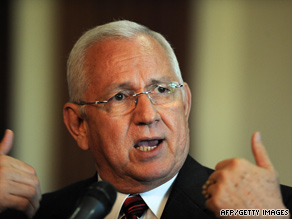
TEGUCIGALPA, Honduras (CNN) -- Roberto Micheletti, the de facto president of Honduras, announced Monday that he would lift an emergency decree that allows authorities to limit constitutional rights such as freedoms of expression, travel and gathering in public. But repeal of the law would not be immediate, pending a legal review, he said.
Pro-Zelaya demonstrators take to the streets Monday in Tegucigalpa, Honduras, on Monday.
Click to view previous image
1 of 3
Click to view next image
The about-face on the policy came at a news conference less than a day after he imposed it in response to unrest that increased significantly September 20 when ousted President Jose Manuel Zelaya secretly returned to Honduras and obtained refuge in the Brazilian embassy.
The 45-day decree announced Sunday night forbids any unauthorized public gatherings, allows officials to make arrests without a judicial order and lets the government close down news media that threaten "peace and order."
Micheletti said he would consult with the supreme court to repeal the decree, following a meeting with the leading presidential candidates.
"This decision was made because (Zelaya) was calling for insurrection...but I'm going to listen to the other powers of the state and we're going to make the most wise decision in the interests of Honduras," Micheletti said, according to the newspaper La Prensa.
Monday marked the three-month anniversary of Zelaya's ouster June 28 in a military-led coup that has had many twists, but little progress toward an end to the country's political turmoil.
The slow progress appeared to frustrate one American diplomat.
Following a day-long special session of the Organization of American States Monday in Washington, the U.S. delegate at the meeting, Lewis Amselem, told ambassadors that the organization was moving too slowly.
"We are looking increasingly foolish," he said during a closed session. He was not aware that microphones in the room were still live from a previous open session, and that his remarks were inadvertently recorded.
"What is the purpose of this declaration? It should've been a simple short 15 minute project. Should've been to reject the treatment of the OAS officials, the treatment they receive over the weekend," Amselem said, referring to an incident over the weekend where all but one of six OAS representatives were turned away from Honduras.
The U.S. official continued: "Reject the deterioration in human rights, as evidence of the decree of the the facto regime, and call (for) the respect for diplomatic immunity. That should've been it, that should've been it."
" Instead we now had day-long discussion, protracted debate in plain view of the world's press," Amselem said. "We made ourselves look foolish and impotent. I don't think that any amount of Viagra is going to turn that around."
In the wake of Micheletti's decree, Jose Miguel Insulza, secretary general of the OAS, said the Canal 36 TV station and Radio Globo were reported closed.
The owner of Canal 36, Esdras Amado Lopez, told CNN that 60 soldiers entered his station Monday morning to shut it down.
They removed all of the equipment, he said.
"They say that we offended the dignity of the president of Honduras, Roberto Micheletti," Lopez said, adding that he sees his station not as pro-Zelaya, but "pro-people."
Honduran soldiers were stationed in front of the shuttered TV and radio stations and would not allow anyone to enter, CNN correspondent John Zarrella reported.
Zelaya has been holed up in the Brazilian embassy since his covert return to his homeland.
On Monday night, he addressed the United Nations General Assembly via a mobile phone that his foreign minister held up at the podium, where he criticized the closures of the media outlets.
A "serious crime is taking place when the voice of the people is silenced and when the people who are being repressed are likewise silenced," Zelaya said.
The New York-based Committee to Protect Journalists also called for Canal 36 and Radio Globo, to be reopened. Two journalists covering the closures were assaulted by Honduran soldiers, the press freedom advocacy group said.
In a statement released Monday evening, the de facto government addressed the issue of the rejected OAS delegation, calling it a "distortion."
The OAS representatives are welcome to come to Honduras after this upcoming Friday, the statement said, adding that the de facto government had asked the OAS beforehand not to send anyone until the domestic actors had a chance to talk.
The statement came after Micheletti's news conference, but it nonetheless defended the security measures imposed by the de facto government.
Honduras has been in turmoil since Zelaya was forced out of the country and replaced hours later by legislative leader Micheletti.
The United Nations, the OAS and the European Union have condemned the coup and demanded that Zelaya be reinstated. Micheletti has vowed that Zelaya will never return to power and has said the deposed president will be arrested if he comes out of the Brazilian embassy in Tegucigalpa, the nation's capital.
Micheletti has accused Zelaya of using the embassy to instigate an insurrection and this weekend gave the Brazilian embassy 10 days to decide the ousted president's status.
Zelaya has publicly told his followers to avoid confrontations but called on them to march in Tegucigalpa on Monday for a peaceful takeover of the government.
Brazil rejected the Honduran ultimatum.

U.S. to Honduras: End emergency decree now


  • Roberto Micheletti said he would repeal decree but not be immediately
TEGUCIGALPA, Honduras (CNN) -- The U.S. State Department is calling on Honduras' de facto president to immediately rescind an emergency decree that limits constitutional rights such as freedoms of expression, travel and public congregation.
Robert Micheletti, de facto president of Honduras, says he'll repeal an emergency decree, but not immediately.
Pro-Zelaya demonstrators take to the streets Monday in Tegucigalpa, Honduras, on Monday.
Robert Micheletti, de facto president of Honduras, says he'll repeal an emergency decree, but not immediately.
"The freedoms inherent in the suspended rights are inalienable and cannot be limited or restricted without seriously damaging the democratic aspirations of the Honduran people," said State Department spokesman Ian Kelly in a statement late Monday night.
Earlier Monday, Roberto Micheletti announced he would repeal the law, but it would not be immediately. The decree will undergo a legal review, he said.
Still, Micheletti's announcement was an about-face. He had announced the policy less than 24 hours earlier in response to unrest that increased significantly after ousted President Jose Manuel Zelaya secretly returned to Honduras on September 20 and took refuge in the Brazilian embassy.
The 45-day decree announced Sunday night forbids any unauthorized public gatherings, allows officials to make arrests without a judicial order and lets the government close down news media that threaten "peace and order."
Micheletti said he would consult with the supreme court to repeal the decree, after a meeting with the leading presidential candidates.
"This decision was made because (Zelaya) was calling for insurrection ... but I'm going to listen to the other powers of the state and we're going to make the most wise decision in the interests of Honduras," Micheletti said, according to the newspaper La Prensa.
Monday marked the three-month anniversary of Zelaya's ouster in a military-led coup on June 28.
In the wake of Micheletti's decree, Jose Miguel Insulza, secretary general of the OAS, said the Canal 36 TV station and Radio Globo were reported closed.
The owner of Canal 36, Esdras Amado Lopez, told CNN that 60 soldiers entered his station Monday morning to shut it down. They removed all of the equipment, he said.
"They say that we offended the dignity of the president of Honduras, Roberto Micheletti," Lopez said, adding that he sees his station not as pro-Zelaya, but "pro-people."
Honduran soldiers were stationed in front of the shuttered TV and radio stations and would not allow anyone to enter.
The United Nations, the OAS and the European Union have condemned the coup and demanded that Zelaya be reinstated. Micheletti has vowed that Zelaya will never return to power and has said the deposed president will be arrested if he comes out of the Brazilian embassy in Tegucigalpa, the nation's capital.
Micheletti has accused Zelaya of using the embassy to instigate an insurrection and this weekend gave the Brazilian embassy 10 days to decide the ousted president's status. Brazil rejected the Honduran ultimatum.
On Monday night, Zelaya addressed the United Nations General Assembly via a mobile phone that his foreign minister held up at the podium.
A "serious crime is taking place when the voice of the people is silenced and when the people who are being repressed are likewise silenced," Zelaya said.

Monday, September 28, 2009

The Dictatorship Unmasked:Congress asks Micheletti to Rescind Decree

Reports: Honduran Congress to deny civil liberty suspensions (Extra)

Tegucigalpa - The Honduran Congress will reject the executive decree that restricts personal freedom in the Central American country, radio stations reported Monday.


Honduras' de facto government, through a decree announced Sunday, restricted liberties in response to a call by ousted Honduran President Manuel Zelaya for his supporters to help him return power.
   The decree authorizes police to dissolve unauthorized public meetings and demonstrations. The government banned statements violating 'peace, public order or offending human dignity' and authorized the state telecommunications agency Conatel to suspend radio and television broadcasters.
The decree will require legislative ratification because it restricts constitutional liberties.
Jose Miguel Insulza, secretary-general of the Organization of American States (OAS), said Monday that the measures constitute 'a sort of state of emergency' and would give a free hand to 'those who want to carry out more acts of repression.'
Legislators for the Liberal Party - the Honduran ruling party under both Zelaya and de facto Honduran leader Roberto Micheletti - and the opposition National Party would reportedly reject the decree, as would the Christian Democratic Party.
The independent Supreme Electoral Tribunal (TSE) spoke out against the decree, arguing that it is counterproductive ahead of the scheduled November 29 presidential election.
Congress Speaker Jose Alfredo Saavedra and the leaders of several party factions were reportedly meeting with Micheletti to let him know they would reject the decree


Última Hora Last Minute

  The Congress calls to repeal the suspension of guarantees and Micheletti said he would consult

Tegucigalpa, Sep 28 (EFE) .- The president of the Honduran Congress, Jose Alfredo Saavedra, today asked the repeal of a decree that from this weekend suspended several constitutional guarantees and the de facto ruler, Roberto Micheletti, said he will consult for make a decision. 
 "I will consult with the Supreme Court of Justice, the Supreme Electoral Tribunal, even if there is opportunity to speak with presidential candidates (...) and make the decision most appropriate to the interests of our country that (.. .) will repeal that decree in the most opportune time, "said Micheletti.

  "At the end of this week we're giving solution to this," said Micheletti, to ensure that Parliament accepted the proposal to encourage dialogue.
The de facto government on Saturday issued a decree which suspended for 45 days the freedoms of movement and expression and prohibit public gatherings, among other measures, according to Micheletti, by the call to the "insurrection" by the deposed president Manuel Zelaya.
He recalled that the decree be repealed if a Council of Ministers, the same way it was approved.
  Saavedra said they made "a respectful request (...) in the sense of analyzing the possibility of leaving the effect worthless and executive decree to which reference has been made since yesterday and today."
  "Everything with the aim to contribute, take this opportunity to promote dialogue in Honduran society," he added.
  Covered by the decree published in the Official Gazette on Saturday and released Sunday, the government closed today Micheletti two media and prevented the march of supporters of Zelaya in Tegucigalpa and elsewhere in the country on the day on which serve three months of the coup.
Zelaya, who a week ago is at the Brazilian Embassy in Tegucigalpa, has strongly criticized the suspension of the rights of citizenship that prevent their supporters demonstrate for restitution in the Chair.


Honduras to restore liberties after criticism
TEGUCIGALPA, Honduras — The coup-installed government in Honduras is backing off of its increasingly desperate measures to hold onto power. Interim President Roberto Micheletti says an emergency decree restricting civil liberties for 45 days will soon be lifted. He made the statement Monday afternoon, less than a day after his government imposed the emergency order.
Supporters of ousted President Manuel Zelaya tried to demonstrate in the Honduran capital, but riot police surrounded them and prevented them from marching. They sat down in the street and vowed not to move until their protest was allowed.
THIS IS A BREAKING NEWS UPDATE. Check back soon for further information. AP's earlier story is below.
TEGUCIGALPA, Honduras (AP) — The coup-installed government in Honduras took increasingly desperate measures to hold onto power Monday, suspending civil liberties, silencing dissident broadcasters and facing off with hundreds of protesters in the street.
The interim government of Roberto Micheletti, who took office after a June 28 coup, banned a march in support of ousted President Manuel Zelaya and ringed the protesters with riot police.
But at a meeting in Washington, the U.S. representative to the Organization of American States called Zelaya's return "irresponsible and foolish."
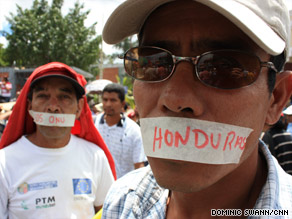
The marchers, many of whom covered their mouths with tape to protest government censorship, sat down in the street and vowed not to budge until they were allowed to demonstrate.
Protest leaders insisted that thousands more Zelaya supporters were trying to join but were stopped from leaving poorer neighborhoods or from traveling from the countryside.
"There is brutal repression against the people," Zelaya told The Associated Press in a telephone interview Monday from the Brazilian Embassy, where he has been holed up with 60 supporters since sneaking back into the country on Sept. 21.
Protests have seen little violence so far — the government says three people have been killed since the coup, while protesters put the number at 10. But protest leader Juan Barahona said that could change.
"This mass movement is peaceful, but to the extent they repress us, fence us in and make this method useless, we have to find some other form of struggle," he said.
Authorities cited their fear of violence when they issued an emergency decree Sunday that limits civil liberties for 45 days. The decree bans unauthorized gatherings and lets police arrest people without warrants, rights guaranteed in the Honduran Constitution. It also allows authorities to shut news media for "statements that attack peace and the public order, or which offend the human dignity of public officials, or attack the law."
Government soldiers raided the offices of Radio Globo and the television station Channel 36, both critics of the Micheletti government, and silenced both. Afterward, the TV station broadcast only a test pattern.
Radio Globo employees scrambled out of an emergency exit to escape the raid that involved as many as 200 soldiers.
"They took away all the equipment," said owner Alejandro Villatoro. "This is the death of the station."
Two journalists covering the raid for Mexico's Televisa and Guatemala's Guatevision were beaten by security forces, who also took their camera, according to Guatemala's ambassador to the Organization of American States, Jorge Skinner. He asked the InterAmerican Human Rights Commission to intervene.
The OAS held an emergency meeting in Washington on Monday after Honduras expelled members of an OAS advance team trying to restart negotiations between the two sides. Foreign Minister Carlos Lopez said the team had not given advance notice of its arrival.
U.S. State Department spokesman P.J. Crowley condemned the expulsion.
"I think it's time for the de facto regime to put down the shovel," he said. "With every action they keep on making the hole deeper."
Lew Amselem, the U.S. representative to the OAS, also had harsh words for Zelaya. He said returning without an agreement "serves neither the interests of the Honduran people nor those seeking the peaceful reestablishment of the democratic order in Honduras."
He added: "Those who facilitated President Zelaya's return ... have a special responsibility for the prevention of violence and the well-being of the Honduran people." He did not say to whom he was referring.
The increasingly authoritarian actions by the interim government signaled an abrupt shift in strategy after appealing for foreign support and arguing it ousted Zelaya to preserve democracy.
Only last week, Micheletti argued in a letter to the Washington Post that his government was not a coup, citing as evidence that freedom assembly was still allowed: "They do not guarantee freedom of the press, much less a respect for human rights. In Honduras, these freedoms remain intact and vibrant."
He argued that the international community will have no choice but to recognize a Nov. 29 vote — "the ultimate civil exercise of any democracy — a free and open presidential election."
Zelaya supporters noted that the emergency decree effectively outlaws any campaigning until two weeks before election day.
"If they can't campaign ... what happens then to the electoral solution?" asked protest leader Rafael Alegria.
That prospect drew criticism of the government even from conservative circles. National Party presidential candidate Porfirio Lobo said: "We will not support nor approve anything that restricts freedom of expression."
Analysts called the shift a sign that the Micheletti government is feeling increasingly threatened.
"It certainly shows that they're worried that Zelaya might be able to disrupt the government," said Heather Berkman, a Honduras expert with the New York-based Eurasia Group. "Zelaya's only recourse really is to mobilize people on the streets. I'm sure that Micheletti and the government know that and they're going to do whatever they can to prevent that."
She called it a risky move: "They're damaging their own credibility, and really hurting the economy."
And in a growing diplomatic feud, Micheletti's government on Sunday gave Brazil 10 days to turn over Zelaya for arrest or grant him asylum, presumably to remove him from Honduras. Brazilian President Luiz Inacio Lula da Silva said his government "doesn't accept ultimatums from coup-plotters."
Lopez said Brazil's withdrawal of its ambassador amounted to breaking relations, meaning the Embassy no longer has diplomatic immunity and implying authorities could raid it, though Micheletti has vowed not to do so.
International law expert Michael J. Glennon at Tufts University said such a raid would violate international law.
"One country can't say to another, we're de-recognizing you, this is no longer an embassy," Glennon said. "I'm sure that that kind of subterfuge wouldn't work under international law."
Associated Press writers contributing to this report included Freddy Cuevas in Tegucigalpa and Martha Mendoza and Catherine Shoichet in Mexico City.


The Dictatorship Unmasked

"The Real Goal of the 45-Day Curfew is to Torpedo November's Electoral Process"
El Tiempo Staff Editorial
translated by Kristin Bricker
With Executive Decree PCM-M-016-2009, the dictatorial government has taken off its mask and really outdone itself by keeping Honduras and the Honduras people kidnapped through its use and abuse of the State's weapons and its desire to manipulate the Constitution and the laws of the Republic.

This executive decree, signed by the de facto head of state Micheletti in a meeting with his equally de facto cabinet, establishes a curfew for 45 consecutive days, during which practically all rights and individual freedoms are annulled, leaving the Honduran people completely defenseless before the usurpers.

From the moment this dictatorial edict went into effect, inalienable rights such as personal freedom, the right to free thought, the right to organize and meet, the right to free movement, rights to privacy in one's own home, and protections against arbitrary detentions ceased to exist in Honduras.

Honduras is at the mercy of a dictatorship that has tried to enthrone itself against the will of an entire people. Honduras is an international pariah and a State that has been kidnapped by a group of unscrupulous and adventurous politicians, military officials, businessmen, and religious kingpins who have no consciences. They maintain omnipotent power over the government in order to enjoy absolute impunity, privileges, and canonry.

As for freedom of expression, which is fundamental to human coexistence and democracy, article 73 of the Constitution of the Republic states:
Printing presses, radio and television stations, and whichever other means of emitting and broadcasting thought, as well as their components, cannot be confiscated, nor closed, nor can their work be interrupted on the grounds that they are committing a crime in transmitting their thoughts, their responsibilities under the law notwithstanding.
We cite that constitutional article for informational purposes. We know that for a dictatorial, totalitarian government, like that which holds power in Honduras, "the Constitution is pure drivel" and "can be violated as much as is necessary," according to the subculture of the political "class" that has brought our country to the point of complete political, economic, and social disaster.

Article 3.3 of executive decree PCM-M-016-2009 prohibits: "Publication in any media, spoken, written or televised, of information that offends human dignity, public officials, or criticizes the law and the government resolutions, or any style of attack against the public order and peace." All of this, naturally, is according to the dictatorial regime's criteria and in no way according to democratic mentality.

It is obvious, therefore, that with the 45-day curfew--that is, for the duration of the election campaigns--the real goal is to torpedo November's electoral process through a plan to consolidate the dictatorship's power, unmasking the de facto regime's faked determination to support the general elections at the end of the year.

This is because there cannot be an electoral campaign without individual freedoms, without the freedom of expression or transmission of thought, without the freedom of association and the freedom to hold meetings, without free transit and the right to privacy in one's own home, and without protections against arbitrary detentions. That is very clear.

Fuente:narcosphere.narconews.com


Congress asks Micheletti to Rescind Decree

The head of congress, Jose Angel Saavedra, met with Roberto Micheletti and Ramon Velasquez Nassar, vice president of the Congress, Antonio Rivera Callejas, Liberal Party member, and Ricardo Rodriguez, Liberal Party member, to ask that Micheletti rescind the decree issued sunday night.

The Nationalist party has come out and said they will not vote for it when it comes up for approval in Congress.

Radio Globo, broadcasting on the internet from a clandestine studio, reported a few minutes ago that the measure likely will not pass if it comes to a vote in Congress. They cited Jose Azcona as their source.

Update 2:30 PM PDT: La Tribuna reports that the Congressional leadership has met with Micheletti and asked him to rescind the decree suspending parts of the constitution. Antonio Rivera Calleja, a congressman, pointed out that the Executive branch has ways of punishing media that break the law. He said the motiviation for asking Micheletti to rescind the decree was to open a space for dialogue that the country requires.

The vice president of Congress, Ramon Velasquez Nazar, said it would be better if Micheletti rescinded the decree before sending it to Congress for approval.

Jose Angel Saavedra, president of Congress, said that they brought the proposal to the executive branch, and it was up to them to decide if they want to reform or rescind this ordinance.

"We want to foster dialog, we want to send a message to the international and national community that the management of Congress, the heads of the political parties represented in the legislature, we want to contribute to a great dialogue which is what we are hoping for," said Saavedra.

The Battle for Honduras
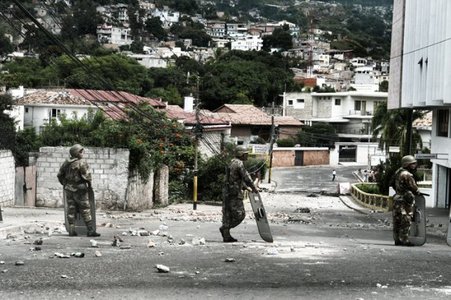
tegucigalpa guerra


What happens in Honduras will be decisive for the future of all Latin America. At stake is the chance of defeating the extreme right-wing continental project to deny the impoverished majority in Latin America meaningful political participation and a decent life. Whether in government  - as in the United States, Canada, Colombia, Mexico, Peru and Panama – or in recalcitrant, entrenched opposition as elsewhere in the Americas, the continent's extreme right-wing elites are determined to use Honduras as a laboratory for their continental project. toni solo reports.

CENTER FOR JUSTICE AND INTERNATIONAL LAW CONDEMNS RESTRICTIONS OF FUNDAMENTAL FREEDOMS IN HONDURAS

De Facto Government are attacking foreign and domestic journalists

Ariela Caceres radio GLOBO reports: Delmer Membreño photojournalist newspaper The Liberator, was captured, beaten, burned his body with cigarettes, took away his computer and was freed on the outskirts of Tegucigalpa, sent message to the editor of the newspaper they will kill him ...
  ASSAULT ON MEXICAN JOURNALISTS
The reporter and cameraman Alberto Cardona Rony Sanchez, special envoys to Honduras, they were beaten by police officers de facto government Micheletti, while covering the taking of a broadcaster
 28, 2009 .- Alberto Cardona, Televisa Newscasts envoy to Honduras, Rony Sanchez and his cameraman were attacked in Tegucigalpa Monday while covering the political crisis in that country after the coup against President Manuel Zelaya.
A primeras horas de la mañana de este lunes, el reportero y su camarógrafo se dirigieron hacia la radiodifusora hondureña Radio Globo pues se les había informado que las fuerzas militares y policíacas, fieles al presidente de facto, Roberto Micheletti, habían tomado dicha radiodifusora con la intención de sacarla del aire. In the early hours of Monday morning, the reporter and his cameraman headed to the Honduran radio station Radio Globo as they had been informed that the military and police forces, loyal to the de facto president, Roberto Micheletti, the broadcaster had taken the intention of removing it from the air.
As Alberto Cardona and Rony Sanchez performed the coverage of the facts arrived at the scene on patrol with police officers who began to beat the collaborators television news programs.
The police seized the camera and removed Rony Sanchez also money and passport.  They were at gunpoint by officers, who demanded they hand over the material that was recorded during the making of the radio station.
  Cardona and Sanchez did not suffer serious injuries, but bruising from blows to the arms, legs and stomach.
After the beatings and assaults to which they were subjected, the reporter and cameraman were followed for several minutes as they headed to their hotel.
The events did not happen during a demonstration or confusion, it became clear that the police officers went directly against the partners of Newscasts Televisa, while they performed their work.
  On Sunday afternoon three photographers also international agencies were overwhelmed by an unmarked vehicle. One of them, of Salvadoran origin, is injured in one leg due to beatings after being struck.
 Guatemala denounces attack on two journalists in Honduras
Guatemala's government denounced on Monday to the Organization of American States (OAS) to Honduran police arrested and beat two Guatemalan journalists in Tegucigalpa, so it demanded the intervention of the Inter-American Commission on Human Rights.
Guatemala's ambassador to the OAS, Jorge Skinner said in a special session of the OAS Permanent Council that journalists Alberto Cardona and Rony Sanchez, Guatevisión, were beaten and subjected to "harassment" and were unaware of his whereabouts.
  "Not knowing of his whereabouts and physical condition, Guatemala's government blames the de facto authorities for the safety and welfare of journalists," said Skinner.
  The representative initially said the military aggression committed them, but soon corrected himself and said he had clarified that the taunts were part of police.
The OAS Permanent Council cited a new special session after the Honduran government refused entry facto a hemispheric organization's mission to prepare a visit of foreign ministers, in addition to the suspension of various individual rights.
vos
Honduras' interim gov't silences key broadcasters
TEGUCIGALPA, Honduras — Honduras' coup-installed government silenced two key dissident broadcasters on Monday just hours after it suspended civil liberties to prevent an uprising by backers of ousted President Manuel Zelaya. Dozens of soldiers raided the offices of Radio Globo. Officials also shut down Channel 36 television station, leaving it broadcasting only a test pattern.
Rene Zepeda, a spokesman for the interim government, said the two outlets had been taken off the air in accordance with a government emergency decree announced late Sunday that limits civil liberties and allows authorities to close news media that "attack peace and public order."
Supporters of the deposed leftist president vowed to march in the streets Monday in defiance of the emergency order and carry out what Zelaya calls a "final offensive" against his ouster on the three-month anniversary of the coup.
"They took away all the equipment. This is the death of the station," said Radio Globo owner Alejandro Villatoro, describing the dawn raid on the station.
Station employees scrambled out of an emergency exit to escape the raid that Villatoro said involved as many as 200 soldiers.
He said the office remained surrounded by soldiers. It was the second time soldiers have barged into the station — the first was June 28, the same day Zelaya was ousted.
The interim government has long argued it is trying to preserve democracy in Honduras, and even cited the fact that pro-Zelaya media such as Channel 36 were operating freely as proof.
But the emergency decree showed a tough new stance domestically and internationally, a reversal from last week, when interim President Roberto Micheletti indicated his administration was willing to hold talks with Zelaya, who has taken shelter at the Brazilian Embassy after sneaking into the country a week ago.
The Organization of American States in Washington called a high-level emergency meeting on Monday to discuss the Honduras crisis after the interim government expelled at most members of an OAS advance team that had arrived Sunday to try to restart negotiations.
Micheletti's Foreign Minister Carlos Lopez said the team had not given advance warning of its arrival and said it did not come "at the right time ... because we are in the middle of internal conversations."
Officials also issued an ultimatum to Brazil on Sunday, giving the South American country 10 days to turn Zelaya over for arrest or grant him asylum and, presumably, take him out of Honduras.
Lopez said Brazil had broken relations by withdrawing its ambassador and said if it does not restore ties, the diplomatic mission would become a private office — implying it could be raided by police.
Brazilian President Luiz Inacio Lula da Silva responded, saying that his government "doesn't accept ultimatums from coup-plotters."
Micheletti has pledged not to raid the embassy where Zelaya has been holed up with more than 60 supporters.
The building is surrounded by armed police and soldiers, who have been there since baton-wielding troops used tear gas and water cannons to chase away thousands of his backers when he returned to the country Sept. 21.
Protesters say at least 10 people have been killed since the coup, while the government puts the toll at three.
The government's suspension of civil liberties limits rights guaranteed in the Honduran Constitution: The decree prohibits unauthorized gatherings and allows police to arrest without a warrant "any person who poses a danger to his own life or those of others." It also allows officials to shut down media outlets for "statements that attack peace and the public order, or which offend the human dignity of public officials, or attack the law."
The Honduran Constitution forbids arrests without warrants except when a criminal is caught in the act.
In a nationally broadcast announcement, the government explained it took the steps it did "due to the calls for insurrection that Mr. Zelaya has publicly made."
Zelaya is demanding to be reinstated and has said that Micheletti's government "has to fall."
While many nations have announced they would send diplomatic representatives back to Honduras to support negotiations, the interim government said Sunday that it would not automatically accept ambassadors back from some nations that withdrew their envoys.

Trade Groups Pressure Clinton on Honduras

Trade Groups Pressure Clinton on Honduras
by Kristi Ellis
Posted Monday September 28, 2009
From WWD Issue 09/28/2009
WASHINGTON — A coalition of fashion trade associations called on Secretary of State Hillary Clinton to pressure the Honduran government to fully restore commercial activity,...


IFJ said that journalists have the right to work freely in Honduras

  Brussels, Sept. 28 (EFE) .- The International Federation of Journalists (IFJ) today urged all journalists and media in Honduras have "right to work freely and without threats," after the de facto government of Honduras has closed two media critical of the coup. Continue reading the printed article
  The IFJ said in a statement its "maximum sentence" for the closure and militarized Radio Globo television network Channel 36, both headquartered in Tegucigalpa and related to the deposed president, Manuel Zelaya.
"We reject aloud the de facto Government's efforts to punish those who report on the activities of the country's legitimate president or report the demonstrations in the streets and in the media, continue to reject the coup," said The IFJ General Secretary Aidan White.
  The Federation alleged that the administration of the current president, Roberto Micheletti, has issued a decree that allows closures, restrictions and censorship of the media favor the legitimate president. "
Thus, said he supports the demands of its affiliates in the region and the Federation of Journalists in Latin America and the Caribbean (FEPALC) requiring the cessation of all attacks against the media trying to "report freely on the crisis or the activities of Manuel Zelaya, ousted in late June by a military coup.
The IFJ also noted the request for guarantees of the Special Rapporteur for Freedom of Expression of the Organization of American States (OAS), which noted "further deterioration of freedom of information and journalists" since Zelaya returned to Honduras and took refuge in the Brazilian embassy more than a week ago.
  According to the minutes of the OAS, Channel 36 and Radio Globo had already suffered before blockade and power outages and technical means of transmission.
  "The accusing finger pointed Roberto Micheletti accusing them of 'media terrorism', simply because they reported the return of Zelaya," he said IFJ.
  While he said that other media like Radio Progreso, the department of Yoro, have decided to discontinue its operation "to threats from the military," and stressed that its director, the priest Ismael Moreno, has been threatened with death.
On the other hand, lamented that reporters from Reuters and Associated Press were forced to leave the area for the dispersal of demonstrators showed their support Zelaya near the Brazilian embassy.
  IFJ also reported the case of Radio Liberty journalist Agustina Flores, who was "savagely beaten and detained.


CEJIL CONDENA RESTRICCIÓN DE
LIBERTADES FUNDAMENTALES EN HONDURAS

San José, Costa Rica, 28 de septiembre de 2009

El Centro por la Justicia y el Derecho Internacional (CEJIL) condena el decreto emitido por el gobierno de facto de Honduras, publicado el pasado sábado 26 de setiembre que suspende durante 45 días las garantías constitucionales, y a la vez repudia la toma militar y cierre, esta mañana, de Radio Globo y Canal 36.

CEJIL también expresa su más profundo disgusto por la detención y expulsión de una misión preparatoria de la OEA que intentó ingresar ayer a Honduras.

El decreto ejecutivo PCM-16-2009 impone nuevamente el toque de queda, suspende la libertad de tránsito, prohíbe las reuniones públicas no autorizadas por la policía o el ejército, impide la libre expresión y autoriza la suspensión de cualquier radioemisora o canal de televisión que ofenda funcionarios gubernamentales o atente contra resoluciones gubernamentales.

Las amenazas contenidas en el mencionado decreto se concretaron esta mañana cuando efectivos militares procedieron a cerrar el Canal 36 y Radio Globo. En este último lugar representantes del Comité de Familiares de Detenidos Desaparecidos (COFADEH) intentaron levantar un acta del cierre y se les impidió el acceso a las instalaciones por parte de las fuerzas de seguridad. Estas actuaciones dejan al descubierto las verdaderas intenciones represivas del gobierno de facto.

En este contexto, en el cual, los y las hondureñas no pueden ejercer sus derechos civiles y políticos con libertad, es evidente que no existen las condiciones para que se lleve a cabo una campaña electoral. Actualmente no hay espacio para el debate político ni para que los ciudadanos se informen y se expresen sin temor a sufrir represalias.

A los hechos antes citados se suma la muerte de Wendy Elisabeth Ávila, debido presuntamente a los efectos de gases lacrimógenos lanzados por fuerzas policiales y militares, y las agresiones sufridas por dos periodistas guatemaltecos, Alberto Cardona y Rony Sánchez, de Guatevisión, quienes fueron golpeados y sometidos a vejámenes por parte de elementos policiales.

“Hacemos un llamado al Congreso de la República de Honduras para que conozca el decreto que establece la suspensión de las garantías constitucionales y lo impruebe, y  pedimos a la Corte Suprema de Justicia que declare la inconstitucionalidad de ese documento. Para CEJIL es urgente que tanto el Congreso como la Corte suprema de Justicia intercedan para autorizar una visita urgente de la Comisión Interamericana de Derechos Humanos, que verifique la situación de derechos humanos en  Honduras”, dijo la directora ejecutiva de CEJIL, Viviana Krsticevic.

Contacto en Costa Rica
Nancy Marín Espinoza
Difusión y Prensa
Tel: 506-2280-7473/7608
Fax: 506-2280-52
Correo electrónico: nmarin@cejil.org


El Centro por la Justicia y el Derecho Internacional (CEJIL) es una organización de defensa y promoción de los derechos humanos en el hemisferio americano. El objetivo principal de CEJIL es asegurar la plena implementación de normas internacionales de derechos humanos en los Estados miembros de la Organización de Estados Americanos (OEA), mediante el uso efectivo del sistema interamericano de derechos humanos y otros mecanismos de protección internacional. CEJIL es una organización no gubernamental sin fines de lucro con estatus consultivo ante la OEA, la Organización de las Naciones Unidas (ONU) y con calidad de observador ante la Comisión Africana de Derechos Humanos.


Brazil: Time to say stop the de facto government - The Government of Brazil requested the Security Council to meet to discuss the situation that now the Brazilian Embassy in Tegucigalpa, the Honduran people.A group of lawmakers in Brazil is preparing to travel to Honduras


  Micheletti closes media and  impedes marches for three months after the coup

Tegucigalpa, 28 sep (EFE).- El Gobierno de facto de Roberto Micheletti clausuró hoy dos medios de comunicación e impidió que los seguidores del presidente depuesto, Manuel Zelaya, marcharan por Tegucigalpa y otros puntos de Honduras, que cumple tres meses del derrocamiento en estado de sitio. Seguir leyendo el arículo Tegucigalpa, Sep 28 (EFE) .- The de facto government of Roberto Micheletti today concluded two media and prevented the followers of the deposed president, Manuel Zelaya, marched through Tegucigalpa and elsewhere in Honduras, which has three months of the overthrow siege. Continue reading the printed article
  Just hours after the government reported Sunday night in a decree suspending several constitutional guarantees, including freedom of the press, police and military forces stormed to 0520 local time (11.20 GMT) on Radio Globo to take facilities.
  The intervention was "the same as when they entered the 28th day of June," he told Efe the owner of the medium, Alejandro Villatoro, recalling the date on which the military ousted the country and the power to Zelaya.
The closure of the building did not, however, managed to outwit the media and police closed the air out again through the Internet, broadcasting from a house, said Villatoro.
Less fortunate was the Channel 36 television, Cholusat South also involved and their facilities surrounded by policemen and soldiers who block the way from early morning.
  Both Radio Globo Cholusat South are two of the few media outlets have broadcast the views of Zelaya and his followers in Honduras since the coup.
  The closure was made under a decree suspending constitutional freedoms of press, assembly and movement, among others, for 45 days.
  This rule bans "by any means (...) publications that offend human dignity of  public officials or violate the law and Government resolutions, or otherwise undermine the peace and public order."
About two hundred policemen prevented the march scheduled today in the Honduran capital by the National Resistance Front against the coup, which brings together social groups and unions.
  The police took up positions on either side of the street of the Pedagogical University, usual place of beginning of the march since the overthrow of Zelaya, preventing the movement of hundreds of protesters.
. The operation includes a helicopter and a riot truck with a water cannon that has been moved to the area.
"Truth is the same all over the country, is preventing people to go out and demonstrate," he peasant leader Rafael Alegria, one of the leaders of the Front told reporters .
  "We hope the Congress does not approve the decree that restricts the rights of the people by this government coup that wants to stay in power beyond the election and January 27, when the mandate ends of Zelaya, said the ruling also Front Juan Barahona.
  Barahona referred to the approval to be given by Congress within 30 days a decree suspending the guarantees and also was criticized today by the presidential candidate of the National Party, Porfirio Lobo, the leader in polls for elections November.
  "We can not be in favor of anything that restricts what is a right for all, which is the most sacred thing we have, which is freedom," he told local journalists.
Ambassador John Bielh, senior adviser to the secretary general of the Organization of American States (OAS) to Honduras, also regretted the suspension of guarantees.
  "We all know what they mean restrictions on press freedom, the actions against journalists are actions that everyone knows, which decrease and attack the very heart of democracy," he told Efe , adding: "We will work so this is reversed.
  In this regard, said the general secretary, Jose Miguel Insulza, could come to Honduras together with a mission of foreign ministers before Thursday.
  "I think that in principle should be Wednesday or Thursday, because it depends heavily on the possibility of foreign ministers, all of which have very high-level functions and a lot of concern and desire in the case of Honduras, but will not come a tourist or talk, "he said.

Última Hora Last Minute

Irán prueba nuevos misiles en juegos de guerra, según la TV Iran tests more missiles in war games, according to the TV

The Dictatorship Unmasked

Posted by Kristin Bricker - September 28, 2009 at 2:42 pm "The Real Goal of the 45-Day Curfew is to Torpedo November's Electoral Process"
El Tiempo Staff Editorial translated by Kristin Bricker
With Executive Decree PCM-M-016-2009, the dictatorial government has taken off its mask and really outdone itself by keeping Honduras and the Honduras people kidnapped through its use and abuse of the State's weapons and its desire to manipulate the Constitution and the laws of the Republic. 

This executive decree, signed by the de facto head of state Micheletti in a meeting with his equally de facto cabinet, establishes a curfew for 45 consecutive days, during which practically all rights and individual freedoms are annulled, leaving the Honduran people completely defenseless before the usurpers.

From the moment this dictatorial edict went into effect, inalienable rights such as personal freedom, the right to free thought, the right to organize and meet, the right to free movement, rights to privacy in one's own home, and protections against arbitrary detentions ceased to exist in Honduras.

Honduras is at the mercy of a dictatorship that has tried to enthrone itself against the will of an entire people.  Honduras is an international pariah and a State that has been kidnapped by a group of unscrupulous and adventurous politicians, military officials, businessmen, and religious kingpins who have no consciences.  They maintain omnipotent power over the government in order to enjoy absolute impunity, privileges, and canonry.

As for freedom of expression, which is fundamental to human coexistence and democracy, article 73 of the Constitution of the Republic states:
Printing presses, radio and television stations, and whichever other means of emitting and broadcasting thought, as well as  their components, cannot be confiscated, nor closed, nor can their work be interrupted on the grounds that they are committing a crime in transmitting their thoughts, their responsibilities under the law notwithstanding.
We cite that constitutional article for informational purposes.  We know that for a dictatorial, totalitarian government, like that which holds power in Honduras, "the Constitution is pure drivel" and "can be violated as much as is necessary," according to the subculture of the political "class" that has brought our country to the point of complete political, economic, and social disaster.

Article 3.3 of executive decree PCM-M-016-2009 prohibits: "Publication in any media, spoken, written or televised, of information that offends human dignity, public officials, or criticizes the law and the government resolutions, or any style of attack against the public order and peace."  All of this, naturally, is according to the dictatorial regime's criteria and in no way according to democratic mentality.

It is obvious, therefore, that with the 45-day curfew--that is, for the duration of the election campaigns--the real goal is to torpedo November's electoral process through a plan to consolidate the dictatorship's power, unmasking the de facto regime's faked determination to support the general elections at the end of the year.

This is because there cannot be an electoral campaign without individual freedoms, without the freedom of expression or transmission of thought, without the freedom of association and the freedom to hold meetings, without free transit and the right to privacy in one's own home, and without protections against arbitrary detentions.  That is very clear.
 

A group of lawmakers in Brazil is preparing to travel to Honduras

Brasilia, Sep 28 (EFE) .- Brazilian Deputies will travel to Honduras to feel the situation, meet with parliamentarians of this country and visit the Brazilian Embassy, which houses the deposed President Manuel Zelaya, an official said Friday. Continue reading the printed article
  The visit of legislators, originally scheduled to arrive in Honduras on Thursday, was agreed with the president of the Honduran Congress, Jose Alfredo Saavedra said today Deputy Raul Jungmann, the Partido Popular Socialista Brazil.
The senator explained that another goal of this visit will know "the situation of Brazilians living in Honduras," for fear that they "may suffer reprisals" by the fact that Brazil hosts in his embassy to Zelaya, who is in the embassy since last week returned to the country by surprise.
  Jungmann, a member of the Committee on Foreign Affairs of the House, said it is necessary to "ensure the integrity of Brazilians living in Honduras," are estimated to be about 10,000, and "cooperate in finding a peaceful solution" to the crisis.
  The legislator said the group will meet with Saavedra, who chairs the Honduran Congress since 28 June when Zelaya was overthrown, exiled and replaced by Roberto Micheletti.
  Jungmann said they are also meetings scheduled with members of the Human Rights Commission of the Honduran Congress and other parliamentary authorities.
He also said that aspire to have the opportunity to visit the headquarters of the Brazilian embassy, but did not specify if they wish to converse with Zelaya.
However, he clarified that the group of deputies, whose numbers will be set tomorrow, "expressed no view" on the situation in that country, at least while on Honduran soil.
According Jungmann, the trip would only be suspended "if the next few hours were a growing crisis" that "prevent entry" to this Central American nation.


Zelaya's return increases tension, but also creates opportunities, said Insulza

Washington, Sept. 28 (EFE) .- The OAS Secretary General Jose Miguel Insulza, said today that the return of deposed Honduran president Manuel Zelaya the country "increased tension", but also considered it an "opportunity" for dialogue. Continue reading the printed article
"There is a path breaking, admittedly, not a good situation, but I hope that this situation will break under the assumption that the parties seek a negotiation," the secretary said during the recess of the extraordinary Council called for today, in which are discussing a resolution to condemn the expulsion of a mission from the Organization of American States (OAS) in Honduras.
Insulza stressed the option of dialogue as the only way and stressed the concern of the organization by the declaration of martial law in the country and consequent restriction of freedom of speech, press and assembly.
  Zelaya's return "does not halt the dialogue, was already standing and we were making an effort to resume dialogue," said Insulza.
  The return of the deposed president,he  said, produced "a strong tension, as has been seen recently in the streets of Tegucigalpa, the tension increased and also the opportunity" to resolve the crisis, because "this situation will not  last for two months more. "
Insulza remarked that sooner or later democracy will return to Honduras, because "no country has acknowledged the current government.
  "The biggest resource we have is that no one has recognized the dictatorship and that is the resource that we will keep using" he said.
  The president of Costa Rica, Óscar Arias, who has served as mediator in the conflict, expressed concern that this may lead to a confrontation.
  "I share that, but there is no other alternative than dialogue," said Insulza, who stressed at the prospect of intervention by other countries that "do not solve the problem from outside."
  "History is full of examples of trying to impose democracy from outside" and said that neither the locks nor the cannons used to impose democracy. "El camino es el que hemos emprendido", dijo al respecto. "The road is what we have undertaken," he said about it.
. As for the prospect of intervening in the conflict other international agencies, Insulza said that "if events occur that threaten peace and security in the continent", as he believed "would be an attack on the embassy of Brazil, others Governing bodies like the UN security would have jurisdiction. "
  However, it considered that the conflict affects democracy Honduras and the OAS is the only regional body responsible for this area, as recorded in the Democratic Charter.
  The case of Honduras, "is not threatening peace in the continent," Insulza said. " "In this case we are faced with an attack against democracy and the UN (United Nations) have no mechanism to enter" in this matter, he said.
  "The OAS can still, with the resources they have, work for peace in Honduras," said general secretary, who face criticism in recent months that has not advanced, considered that there has been progress and said: "I I will devote to Honduras to a return to democracy. "

 - 

spacer

The illegitimate president, Roberto Micheletti, seeks to limit the resistance. (Photo: Efe)
El presidente ilegítimo, Roberto Micheletti, pretende limitar a la resistencia. The illegitimate president, Roberto Micheletti, seeks to limit the resistance. (Foto: Efe) (Photo: Efe)
 The Government of Brazil requested the Security Council to meet to discuss the situation that now the Brazilian Embassy in Tegucigalpa, the Honduran people. The South American ambassador called for the international community and the UN continue to make steps forward towards restoring democracy in the Central American country


TeleSUR _ Hace: 01 hora _ TeleSUR ago: 01 hours
  Brazil's ambassador to the Organization of American States, Ruy Casaes, said the situation facing the nation of Honduras is currently not a cause for concern and said it is unconstitutional, so said "it's time to say enough is enough," because fears that the continuation of the illegal government of that country may spread to other regions.

  Casaes said "there is no doubt that there are conditions of threat to international peace," so he asked the international community to respond and reflect in a "sharp" on the next steps we must take to achieve the restoration of democracy in the Central American country.

  The ambassador said that the Brazilian government is clear about the tactics that handles the executive de facto, to delay any solution and thus achieve the legitimacy of any presidential election next November.

" "The de facto regime clearly point towards the desire that no dialogue was (...), the dialogue that revealed a few weeks ago which was the intention, which was to gain time because every time they introduced a new condition or element, said the official.

  It also found that the decree of the de facto government of a state of emergency is a true test of Micheletti does not want dialogue.

On the other hand, facing the facts that lives the Brazilian Embassy in Tegucigalpa, the diplomat said "the regime's de facto authorities attributed to the Brazilian embassy for the entry of President Zelaya in Honduras is a big lie, President Zelaya was submitted to the Brazilian embassy asking to be accepted, "and consider him a legitimate president" of Brazil's reaction could not have been otherwise. "

  For this reason the Government of Brazil requested the Security Council of UN to meet to discuss the security situation that remains present in the Brazilian embassy, mainly by the disrespect for international norms.

Casaes said to the UN  that to some extent Brazil has taken a step in requesting a meeting at the Security Council and asked the international community and the organization continue taking steps forward, to restore democracy and peace in Honduras.


Fuente: teleSUR /kg - PR Source: teleSUR / kg - PR
. .