Thursday, October 1, 2009

The Electoral Tribunal asks Micheletti to repeal the decree suspending the guarantees

¿Who ordered Zelaya to be ousted?

PABLO ORDAZ
El general Romeo Vásquez se desvincula de la expulsión del presidente depuesto Manuel Zelaya


 Micheletti admits supporting  the coup in Honduras
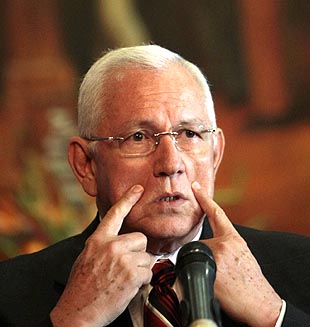
The right-wing sectors in Honduras insist on denying the coup, but the de facto president, Roberto Micheletti, acknowledged today that they deposed Manuel Zelaya for his turn to the Latin American left.

" "We took Zelaya because he went to the left, he placed communists," told Micheletti to  the representative of the Argentine daily Clarin coups, in an interview at the presidential palace in Havana.

  According to Micheletti, the "one mistake" was the way to overthrow the constitutional president, to detain him  and then send him out of the country, as quoted by the newspaper of the South American nation.

  The United Nations Organization reaffirmed this week condemning the military coup and again demanded the restoration of Zelaya in his position as chief executive.
 
  On theHonduran streets described Clarin, the "resistance" in favor of Zelaya "is increasingly controlled by police and military and the: the opposition media were silenced."

Micheletti, who also supports the military coup for alleged "corruption" of the President elected by the people, regretted that Zelaya "befriended Daniel Ortega, Chavez, Correa, Evo Morales," ie, the presidents of Nicaragua, Venezuela, Ecuador and Bolivia.

  During the recent Second Summit of South American-Africa (ASA) in the Venezuelan island of Margarita, the Bolivian president Evo Morales has warned that the coup process gets the nation of Honduras is a warning of imperialism to the countries of ALBA " (Bolivarian Alliance for the Peoples of Our America), an integration mechanism solidarity towards equity and social justice.

Also in response to Clarin, Micheletti considered that the high military presence in public places is because they are "defending democracy, the police alike. It is to guard the inflammatory reaction of Zelaya. They supported us because we were heading towards the abyss."

An International Election Observation Mission on the situation of human rights in Honduras found a different reality: "The Mission concludes that what is at stake is much more than just a political struggle to restore legal order and allow a return to legitimate president power.

  The facts, the report said, show "an unresolved social conflict, which are constituted by a  part of an economic elite that had seized power  in an undemocratic way, allied with the army, and various sectors which require a new institutional and social order that would imply more opportunities for citizen participation.

  "Repression, international observers said, manifests itself in particular against peasant leaders, environmentalists, indigenous, Afro-descendants, women mobilizing for their rights and against trade union leaders.

Honduran power brokers pushing for end to crisis
TEGUCIGALPA, Honduras — Business and political leaders who backed the coup overthrowing President Manuel Zelaya now are considering the unthinkable: returning him to office with limited powers.
The reversal, and Zelaya's decision to consider it, reflect the growing desperation to resolve a three-month standoff that has turned this Central American country upside down.
John Biehl, special adviser to the Organization of American States, said Wednesday he sensed some movement toward talks.
"The moment has arrived for tempers to cool and reason to reign, and that's when errors will start being corrected," Biehl said. "I have found a strong willingness for dialogue," adding he had heard of proposals to return Zelaya to office briefly.
The crisis sparked by the June 28 ousting of Zelaya has paralyzed the already impoverished nation.
Honduras has been bleeding millions of dollars a day, and many of its most prominent CEOs have had their visas revoked by the United States, hampering their efforts to do business. Nations have cut aid to demand the ousted leader's reinstatement while sporadic spikes in tensions have forced the closure of airports, border crossings and factories.
The final straw was the interim government's decision to impose a surprise emergency decree that suspended civil liberties this week and further damaged the administration's image at home and abroad.
Lawmakers immediately made clear Congress will revoke the emergency security crackdown if the interim government does not, said Rigoberto Chang, a congressman with the conservative National Party.
The disagreement over the decree was the biggest public rift between interim President Roberto Micheletti and the Congress that put him in power after soldiers forced Zelaya into exile.
After that happened, Honduras' powerful elite told Micheletti enough is enough, and back- room negotiations began on a powerful business chamber's proposition to put him back in office with limited powers.
Zelaya has said he was encouraged by the proposal and hoped to be in talks with its authors by Wednesday.
Its chief proponent, Adolfo Facusse, president of the National Industry Chamber, suggests sending 3,000 troops from conservative-led nations to Honduras if the leftist leader is restored to office to ensure he does not overstep his limited authority.
Facusse told The Associated Press that the force could be U.N. peacekeepers.
Facusse, whose association vocally supported Zelaya's ouster, said he discussed parts of the plan with Micheletti, including a proposal to make the interim president a congressman-for-life.
Micheletti on Wednesday called parts of the plan impossible but indicated he was analyzing some of its points.
"This involves things we cannot do, because our constitution does not permit it," he said, referring to the presence of foreign troops or U.N. peacekeepers. "But of course we will take into consideration the points he has expressed in his proposal, in his dream to bring peace to Hondurans."
Micheletti did not directly address the issue of reinstating Zelaya, something he has strongly opposed thus far.
The interim leader is becoming increasingly isolated as pressure mounts from the nation's power brokers — including lawmakers, presidential candidates and the business elite — who are demanding a break in the stalemate.
Porfirio Lobo, a top conservative presidential contender, announced that Congress would be open to passing reforms needed to make an accord work.
"The issue is confrontation or dialogue, bloodshed or peace," the National Party candidate said.
"If we have to reform some laws, I don't think Congress is going to be an obstacle," added Lobo, whose party is the second force, with 55 seats, in the 128-seat congress.
The coup's aftermath has presented a tortuous path for presidential candidates trying to campaign ahead of the Nov. 29 elections.
Micheletti sees the balloting, which will produce an entirely new leader, as the country's best hope for emerging from the crisis. But the international community has made it clear that the elections will not be considered valid unless Zelaya is reinstated.
The vote was scheduled before the removal of Zelaya, whose presidential term expires in January.
Micheletti so far has been staunchly opposed to reinstating Zelaya and has been on the defensive since Zelaya sneaked back into the country on Sept. 21 and took refuge at the Brazilian Embassy.
Brazil has expressed concern about the security of the Embassy, where about 60 Zelaya supporters are holed up with the ousted president. Honduran troops and police have surrounded the building.
Six Brazilian legislators were heading to Honduras on Wednesday to check on the South American country's citizens in Tegucigalpa, the state-run Agencia Brasil news agency reported.
Meanwhile, soldiers and police have continued enforcing the security decree despite Micheletti's promises to lift it, putting at risk efforts to restart talks. Micheletti suggested Wednesday it would be in force for at least two more days, as he holds meetings on the proposals for ending the decree.
About 150 police and soldiers acting on the decree Wednesday raided the offices of the National Agrarian Institute, occupied by Zelaya supporters since the coup. Authorities detained 54 people, many farm activists, police spokesman Orlin Cerrato said.
"The decree is being discussed by a lot of sectors, and appeals have been filed," he said. "But it remains in force."
Cerrato said the building contains valuable land title records. One of the detained activists, farmer Jose Irene Murillo, 69, said he feared "they are going to destroy the records of the small farmers, because the big landowners want the land."
Congress can lift or modify the decree issued Sunday that bans unauthorized gatherings and lets police arrest people without warrants, rights guaranteed in the Honduran Constitution. It also allows authorities to shut news media for statements that it sees as disturbing the peace or attacking the law.


A crack appears in Honduras' deadlock

Key backers of the coup that ousted President Zelaya have begun to temper their support for the de facto government. Some said they might even let Zelaya return to office under certain limitations.


Reporting from Mexico City and Tegucigalpa, Honduras -- Themeeting, by all accounts, was tense and difficult. Whether it erupted in shouted insults remains a matter of dispute. On one issue, everyone agreed: Something must be done to ease the political crisis engulfing Honduras.

U.S. Ambassador to Honduras Hugo Llorens and the diplomat representing the Organization of American States, John Biehl, got an earful from Honduran business leaders and senior politicians. And they gave back some of what they got, according to several participants.

But two significant themes emerged from the secret session at Llorens' residence on Sunday, themes that have the potential to finally ease the deepening political crisis that has divided and isolated Honduras and vexed Washington and other regional powers:

Key backers of the coup that ousted President Manuel Zelaya three months ago have begun to temper their support for the de facto government they helped to install. And some even mention a concession until now taboo. They might agree to allow Zelaya to be reinstated and finish his term due to expire in January.

Whether a result of angst over the economic damage caused by international sanctions against Honduras, or more simply a product of exhaustion, these shifts were cemented when de facto President Roberto Micheletti on Sunday suspended civil liberties in a crackdown on opposition press and the public's right to congregate and move about freely. (Micheletti backed down 24 hours later amid cries of outrage from his closest allies.)

The businessmen and politicians who met with Llorens and Biehl spoke of an almost visceral fear of Zelaya and the ways he tried to change the country they had so long dominated, an unwanted push in their view toward socialism. The diplomats, according to participants, repeatedly reassured them that Zelaya's authority would be strictly limited if he is reinstated, under the terms of the so-called San Jose Accord, brokered by Costa Rican President Oscar Arias in July.

"If the accord in fact limits any abuse of power, or political persecution, upon Mr. Zelaya's reinstatement, [then] along those lines we can reach agreement," a former Honduran president who attended the meeting said Tuesday. He asked not to be identified because of the sensitivities of ongoing discussions.

"The international community [condemning the coup] has been unfair with us, but that pressure from the international community is what has pushed us to seek a solution," the former president added.

He echoed similar remarks from Adolfo Facusse, president of the National Industrial Assn., who told The Times a day earlier that the business elite would give "a green light" to putting Zelaya back in the presidential seat under guaranteed limitations on his powers. Facusse added Tuesday that Zelaya would be required to face prosecution on charges that Honduran courts have levied against him since he was deposed, and a multinational military force would be brought to Honduras to verify and enforce the agreement.

Micheletti and other backers of the coup, including military commanders, have said they support the Arias "process," meaning they supported negotiations, though, analysts say, largely as a way to run down the clock. The reinstatement of Zelaya was a nonstarter, they said repeatedly.

They counted on an election scheduled Nov. 29 to choose a new president and restore Honduras to the world's good graces. But increasingly Washington and other capitals announced they would not recognize a president elected under these circumstances. That message also seemed to be getting through to backers of the coup, participants in the meeting indicated. And Micheletti's suspension of civil liberties made some worry the elections might not take place at all.

"A space for dialogue has finally been opened," said a diplomat involved in the meeting. "Many of the businessmen were angry because they are called 'coup backers' and especially because of the U.S. visas being suspended, but they have understood that the international community is not backing down."

Llorens was reportedly in session again Tuesday with business leaders.

All previous efforts at mediating the crisis have failed thus far, largely because of intransigence on both sides. Zelaya, who is holed up in the Brazilian Embassy in Tegucigalpa, the capital, has said he accepts the San Jose Accord, though it remains to be seen whether he would agree to all the limitations that would be placed on him. And if fellow coup-plotters abandon Micheletti, he may dig his heels in deeper.

"To the extent Micheletti is more isolated, his dependence on the military is greater," said Victor Meza, the interior minister in Zelaya's government and another participant in the Sunday meeting with Llorens. "A deeper alliance with military hard-liners . . . is a major obstacle to dialogue and finding a negotiated solution."

The military man who led the coup weighed in Tuesday, encouraging segments of the Honduran population to engage in dialogue. "I see," said Gen. Romeo Vasquez, "we are rapidly approaching a solution."

wilkinson@latimes.com


Businessmen in Honduras Offer Plan to End Crisis


Published: September 30, 2009
TEGUCIGALPA, Honduras — Stung by the loss of their American visas and concerned about Honduras’s increasing international isolation, the country’s leading businessmen have put forward their own plan to resolve the political crisis here.
In the plan, which was made public earlier this week, supporters of the coup that ousted President Manuel Zelaya three months ago have for the first time suggested his return as president. But at the same time the plan calls for him to face trial on charges that he stole money while in office.
“What we’re trying to do is break the ice,” said Adolfo J. Facussé, president of the country’s manufacturing association.
Mr. Facussé said he had put forward his own proposal because he thought that other countries, particularly the United States, were preparing to reject the results of a presidential election scheduled for Nov. 29. The State Department has warned that it may not accept the results if there is no political agreement.
“They continue deteriorating our elections process,” Mr. Facussé said. “This is the most destructive thing they can do in a democracy.”
He added, “The less support the candidates have, the less they can do to solve the problems.”
The United States has stepped up sanctions in stages in an effort to press the de facto government of Roberto Micheletti to negotiate with Mr. Zelaya. After initially suspending military aid and then some economic aid, the United States said in early September that it would revoke visas to members of the de facto government and their supporters.
When Mr. Facussé arrived in Miami on Sept. 12, immigration officials told him that he was no longer welcome. The United States Embassy declined to say which other business leaders had had their visas revoked.
Mr. Facussé and other leaders have proposed that after an accord is reached, troops or police officers from other countries in the hemisphere will keep the peace and an interim multiparty government will take charge. Mr. Zelaya would face trial, but he would not serve prison time if convicted; instead, he would be sentenced to house arrest.
Nelson Ávila, an economic adviser to Mr. Zelaya, said the “plan was born dead.”
“The dialogue is based on the presumption of guilt of President Zelaya, and legally that does not exist,” he said.
There are other signs that the coalition of politicians, businessmen and the military that supported the coup is feeling pressure from the international community. On Monday, the political parties forced Mr. Micheletti to back away from a decree suspending civil liberties.
The main presidential candidates have already tried to jump-start the negotiations, traveling to Costa Rica to meet with the country’s president, Óscar Arias, who has tried to mediate peace talks. Mr. Arias’s proposal, known as the San José Accord, calls for restoring Mr. Zelaya as president, but sharply curtailing his powers. The plan would provide a full amnesty to both sides.
Last week the presidential candidates met with Mr. Zelaya, who secretly returned to Honduras on Sept. 21 and has taken refuge in the Brazilian Embassy.
Mr. Facussé said that Mr. Micheletti agreed to consider his plan after he suggested that Mr. Micheletti step down as leader of the de facto government and be named congressman for life.
Mr. Facussé was clearly dissatisfied with the efforts of other countries to mediate the crisis here. “Because of the bad image the military created, everybody interfered, and we ended up with the San José Accord,” he said.
One of the de facto government’s main supporters in Washington, Senator Jim DeMint, Republican of South Carolina, has announced plans to visit Tegucigalpa on Friday. One Congressional staff member said Mr. DeMint hoped to meet with members of the de facto government and other Hondurans. Other staff members said he intended to encourage Mr. Micheletti and his supporters to resist.
Ginger Thompson contributed reporting from Washington.


The Electoral Tribunal asks Micheletti to repeal the decree suspending the guarantees

 The Supreme Electoral Tribunal (TSE) of Honduras yesterday asked the de facto president, Roberto Micheletti, to repeal the decree  that suspended constitutional guarantees because it affects the process for the November elections. 

  The request was made official by the judges of the TSE David Matamoros and Enrique Ortez Sequeira, at a meeting held with Micheletti in the Presidential House, and joins similar demands made by Parliament, the presidential candidates and other sectors.

Matamoros said in a press conference following the meeting, they asked Micheletti "that the decree should be removed, repealed, so that there is no doubt, no question about the legitimacy of the election on 29 November.

Ortez Sequeira noted that they requested the de facto ruler to "reconsider" and delete the decree, insisting, like Matamoros, that  the TSE guarantees an electoral "transparent"process.
Micheletti said in the same news conference with the two judges, who agreed to consider the application and reiterated that the decree will be "repealed in a timely manner, when the time comes".
  However, he said it would continue consulting with the Supreme Court of Justice (CSJ) and other state bodies in order to make a "consensual"decision .
The decree was published Saturday in The Official Gazette and it suspends constitutional guarantees as freedom of mobilization, assembly and press.
  Various political sectors have criticized the limitation of freedoms and have noted that the decree affected proselytizing activities ahead of elections on 29 November.
  Micheletti issued the decree in a Council of Ministers under the argument that the deposed Honduran President Manuel Zelaya, has called for an uprising from the Brazilian embassy, where he is since the 21st.
Under the decree, Micheletti ended Monday a television channel and radio station, and today the military police and evacuated to 57 followers of Zelaya peasants occupying the Agrarian National Institute for three months to reject the coup June 28.


Micheletti says  "the time has not yet come to sit down and dialogue with Zelaya"

Tegucigalpa, Sep 30 (EFE) .- The de facto president of Honduras, Roberto Micheletti, said today that "it is not yet time to sit and  talk "with the deposed president, Manuel Zelaya, and rejected as unconstitutional certain aspects of the proposal an employer that includes the arrival of foreign troops into the country. 
  "At no time has come the moment when we sit down" with Zelaya, said Micheletti, but confirmed that representatives of the warring parties and other sectors "are talking, they are talking to see how this situation is calm and we can achieve the goal "to resolve the crisis caused by the coup of June 28.
  He reiterated that it is possible that encounter with Zelaya to complete the dialogue, but first they must make their commissions.
. "At the end of the tunnel someone has to sign a document of this nature and of cours they have to be the parties in conflict," Micheletti said in a press conference at the presidential palace.
  He said initial talks "have maintained a little more calmness in  Tegucigalpa" after several days of rioting after Zelaya appeared on past 21 in the Brazilian Embassy in Tegucigalpa, where he remains.
  The de facto government has suspended the constitutional guarantees by a decree that restricts the freedoms of mobilization, assembly and press, among others.
  Micheletti said he remains "open" to dialogue within the mediation of President of Costa Rica, Óscar Arias, and expressed his disapproval of any new proposal to be considered to emerge as an "Agreement of San José II.
  "And why should it be a San Jose Accord II?, If that is an agreement made by Don Óscar Arias. It is an agreement with 12 points, and what you have to do is to discuss the 12 points, removing some of the ones causing internal problems and leaving the ones that  might be feasible to reform ", he explained.
The Arias proposal, he emphasized, "has some things that  the Constitution of the Republic does not allow, but what was written in San Jose is not stone, it can perfectly be reformed.
Micheletti called "speculation", "aspirations" and "dreams" some versions circulating in the press concerning possible solutions to the crisis, but considered "good" to disclose them.
  In particular, he noted that the proposal by businessman Adolfo Facussé, which included the arrival of foreign troops to ensure compliance with an eventual agreement, "covers things" that can not run because "the Constitution does not allow it."
  "We will take some of the points he expresses," said Micheletti, and urged to "go looking at what is reality, what can be reality and what is a dream."
  Facussé leads a group of businessmen who proposed Micheletti to resign if  Zelaya is nominally in charge, but under house arrest, while cabinet ministers running the country under the supervision of foreign troops.
Moreover, Micheletti said   the Brazilian deputies who will pay tomorrow a visit to ascertain the situation of the Embassy in Honduras are "welcome".
 

Cracks deepen among supporters of Honduran coup
TEGUCIGALPA, Honduras — Cracks are deepening among supporters of Honduras' coup-imposed government, with business leaders softening their opposition to reinstating ousted President Manuel Zelaya and lawmakers threatening to revoke an emergency decree limiting civil liberties.
Zelaya said Tuesday night that he was encouraged by a plan proposed by an influential business chamber for putting him back in office and ending the crisis. The plan includes bringing foreign troops to Honduras to ensure that if Zelaya was restored to the presidency, he would respect an international mediator's proposal that his powers be strictly limited.
Zelaya said it was "good sign" that "conservative sectors of the country are analyzing a proposal" that includes his reinstatement.
"We will make the respective analysis," Zelaya said in an interview with Channel 11. "We hope to enter into talks with those who are making this proposal in the next hours."
Lawmakers, meanwhile, made clear Congress will revoke an emergency security crackdown if the interim government does not, Rigoberto Chang, a congressman with the conservative National Party, said Tuesday. Congress has the power to lift or modify the decree.
Interim President Roberto Micheletti backtracked on the decree Monday, saying he had agreed to reconsider the move at the request of congressional leaders. But the order appeared to remain in effect Tuesday.
Police prevented hundreds of demonstrators from marching in support of Zelaya for a second straight day. Two broadcasters that had criticized the coup remained shuttered, although one of them, Radio Globo, was transmitting on the Internet a day after police raided its offices and confiscated equipment.
The disagreement over the security decree was the biggest public rift between Micheletti and the Congress that put him in power after soldiers forced Zelaya into exile June 28 in a dispute over changing the constitution.
The interim government has been increasingly on the defensive since Zelaya sneaked back into the country on Sept. 21 and took refuge at the Brazilian Embassy.
Micheletti initially insisted the government needed to restrict freedom of speech and assembly to counter what he said were calls for "insurrection" by the ousted leader's supporters.
But conservative politicians expressed fear the emergency decree imposed Sunday would endanger the Nov. 29 presidential election, which they consider Honduras' best hope for regaining international recognition. The ballot was scheduled before the removal of Zelaya, whose presidential term expires in January.
Chang said leading conservative lawmakers "weren't even consulted" about the security crackdown.
"It took us by surprise," he said. "We were scared because they weren't taking us into account at all."
Chang criticized the closure of the two pro-Zelaya broadcasters, saying such moves could encourage protesters who have been largely peaceful to turn to violence to get their views across.
"It's less damaging to talk on the television or radio than being on the streets throwing stones," the congressman said. "A decree of that nature could endanger the elections."
Despite the dispute, there has been no groundswell of support among lawmakers for allowing Zelaya to return to power, as governments worldwide have been demanding.
Adolfo Facusse, the president of the National Industry Chamber, proposed over the weekend that 3,000 troops from conservative-led nations be sent to Honduras if Zelaya is restored to office. He said Tuesday that the force could be U.N. peacekeepers.
"Zelaya would have a number of limits on his authority," said Facusse, whose association vocally supported Zelaya's ouster.
Facusse says he discussed parts of the plan with Micheletti, including a proposal to make the interim president a congressman-for-life.
Chang said lawmakers were open to considering any proposals for resolving the political standoff "no matter how unlikely they might appear," but he said there was no need to have foreign troops in Honduras.
Micheletti remains staunchly opposed to putting Zelaya back in office.
Costa Rican President Oscar Arias, the mediator in U.S.-backed talks who put forward the proposal for returning Zelaya to office with limited powers, commended Micheletti for saying he would reverse the security decree. But Arias criticized him for refusing to budge on reinstating Zelaya.
Micheletti "has not moved an inch" in negotiations on returning Zelaya to power, Arias said at a business forum in Miami.
Earlier Tuesday, Gen. Romeo Vasquez, the military chief who oversaw Zelaya's ouster, implored Hondurans on both sides to join in resolving the crisis.
"All sectors of society should put aside their differences to unite the homeland," Vasquez said.
 

Library of Congress Report on Honduran Coup Filled with Flaws

Library of Congress Report on Honduran Coup Filled with Flaws
By Dr. Rosemary Joyce
Upside Down World
Friday, Sep 25, 2009

The following letter was sent to the Library of Congress regarding the very serious errors in the report issued in their name yesterday.

Subject: Serious errors of fact in CRS LL File No. 2009-002965 on Honduras
From: "Rosemary A. Joyce"
Date: Fri, September 25, 2009 12:49 am

Dear Librarian Billingsley and Director Mulhollan,

I write to bring to your attention serious errors of fact in a Congressional Research Service report written by Ms. Norma C. Gutierrez. Given the damage this erroneous report has already done as it circulates in Honduras and the US, I urge you to immediately issue a public correction and withdraw the report, notifying members of Congress that it is unreliable and based on faulty courses and inaccurate information.

Entitled "HONDURAS: CONSTITUTIONAL LAW ISSUES" and dated August 2009, the report was released by Congressman Schock of Illinois today.

It has now been established unequivocally that Ms. Gutierrez' produced a fatally flawed report.

There are four problems with Ms. Gutierrez' analysis:

(1) She cites a single Honduran legal analyst as a source of personal communications "confirming" conclusions she draws. Her source is a known supporter of the de facto regime in Honduras, Guillermo Pérez-Cadalso, who testified on behalf of the de facto regime in July's hearings in the US Congress.

This is not a disinterested source. There are numerous Honduran law professors, as well as constitutional law authorities in the US and Spain, on record in writing finding the Honduran Congress exceeded its legal authority in claiming to remove President Zelaya from office on June 28. None of these authorities is cited.

(2) Ms. Gutierrez, rather than analyze the arguments made by the Honduran Congress, as the questions she was asked would require, creates her own novel theory: that the Honduran Congress used a constitutional power given it to interpret the Honduran Constitution so as to justify its removal of President Zelaya.

Specifically, she suggests that the Congress must have interpreted its Constitutional authority to "disapprove" of the actions of a president, extending the definition of "disapproval" to include "removal from office".

Such a claim was not, however, actually made by the Honduran Congress in its June 28 actions. This is a post-hoc rationalization for their actions proposed by Ms. Gutierrez, apparently with guidance from Mr. Pérez-Cadalso, who is cited as confirming this rationalization in a footnote citing a phone conversation.

(3) In fact, on May 7, 2003, the Honduran Supreme Court had nullified the claimed power of the Congress to interpret the Constitution. Thus, it is not surprising that the Honduran Congress made no such claim on June 28, since they no longer could assert such authority, which the Supreme Court had rejected.

(4) Even during the period when the Honduran Congress acted under the belief it had the power to interpret the Constitution, it was bound by procedures that required it to explicitly note that it was interpreting the constitution, and to define the circumstances of the definitions they proposed..

This did not happen on June 28, almost certainly because no such claim was then being made, because the Congress was aware of the May Supreme Court ruling invalidating this claimed power.

In addition, the Honduran congressional session on June 28 was not the kind of ordinary session that had been defined as allowing constitutional interpretation; it was an "extraordinary session". Honduran Congressional procedure requires that extraordinary sessions be convened based on a call that defines the issues to be discussed, and no other issues can legally
be introduced.

Interpreting the constitution was not on the agenda (again, one can suppose that this was because the Honduran Congress knew on June 28 that the Supreme Court had nullified their claim to have such power over a month earlier).

In reading the CRS, I was struck by the reliance on a single source, via personal communications, to draw such consequential conclusions. There is no shortage of legal scholarship published and available which would have helped Ms. Gutierrez avoid these fundamental errors of scholarship; I mention here only one such source, the widely distributed paper published
online by ASIL (the American Society of Internation Law), written by invitation by Notre Dame Law Professor Doug Cassell.

There are more points that are disturbing in this CRS report. For example, footnote 43 offers a characterization of a forged resignation letter attributed to President Zelaya, backdated to June 24, as being explained as a true letter written for nefarious purposes; the source for this claim, again, is the same supporter of the coup, Mr. Pérez-Cadalso. Yet his claim is widely discredited; the back-dated letter is widely viewed as a forgery produced when the coup was originally scheduled to happen, an event delayed in part by US diplomatic action.

In short, in my view, Ms. Gutierrez produced her unreliable report in large part because she failed to exercise sufficient scholarly caution about one influential, yet unaccountable, source. She did not seek out other opinions. Her search of legal opinion was consequently flawed, as she missed the key Supreme Court decision of May 7, 2003. She went beyond her mandate, which was to explain whether the claims of constitutionality made by the Honduran Congress were accurate, and instead provided a speculative rationalization of their actions.

This report raises serious questions in my mind about the overall reliability of similar reports from the Congressional Research Service. As a scholar, I hope that you will take swift action to restore the credibility of CRS and, by extension, the Library of Congress.

Rosemary A. Joyce
Richard and Rhoda Goldman Distinguished Professor of Social Sciences

Professor and Chair of Anthropology
University of California, Berkeley

Honduras: Coup d’Etat in Constitutional Clothing?

(Click here for Spanish Version)
By Doug Cassel


Introduction
Legal confusion has clouded the recent de facto change of government in Honduras. Some of this arises from the passionate political debate over President Manuel Zelaya and his de facto removal. Without entering that debate, this analysis addresses only questions of international law and related questions of law.
In the early morning hours of Sunday, June 28, 2009, acting on a judicial warrant to arrest President Zelaya for alleged crimes, the nation’s military stormed the presidential palace, and arrested the chief executive in his pajamas. Then, exceeding its warrant, and in violation of an express provision of the Honduran Constitution,[1] the military put the pajama-clad president on a plane to Costa Rica.[2] With Zelaya involuntarily exiled, the Honduran Congress met that afternoon, listened to a reading of a supposed letter of resignation from him, and promptly accepted it.[3] The Congress then issued a decree purporting to depose Zelaya on other grounds, and to replace him by the president of the Congress, Rigoberto Micheletti.[4]
President Zelaya’s removal and replacement were swiftly denounced as a coup d’état by governments throughout the region,[5] including by U.S. President Obama,[6] and by the United Nations General Assembly,[7] the Inter-American Commission on Human Rights,[8] and the General Assembly of the Organization of American States (OAS).[9] Invoking the Inter-American Democratic Charter,[10] the OAS General Assembly termed the coup an “unconstitutional alteration of the democratic order,”[11] thus triggering the suspension of Honduras from participation in the OAS.[12]
Although the United States joined in the 33-0 OAS vote,[13] the Obama Administration stopped short of deeming Zelaya’s ouster a “military coup,” which would trigger a statutorily mandated suspension of U.S. inter-governmental foreign assistance to Honduras.[14] Nonetheless, the Administration suspended military and inter-governmental development aid as a matter of policy.[15] At least one witness at a congressional hearing went further, calling Zelaya’s removal a “military coup” requiring an aid suspension.[16]
By contrast, the removal and replacement of Zelaya were vigorously defended by a broad, if not unanimous,[17] array of Honduran civil authorities – including all 15 members of the Supreme Court,[18] the chief prosecutor,[19] an overwhelming majority of Congress,[20] and the new, de facto government.[21] In written communiqués, they insisted that his ouster was a lawful and constitutional action to defend Honduran democracy and the rule of law from a president who had defied both courts and Constitution, and who was maneuvering to amend the Constitution to allow him to run for a second term.[22] Similar views have been expressed by a number of members of the U.S. Congress.[23]
On the day he was deposed, President Zelaya, in violation of a court order, was attempting to conduct a referendum on whether to call a constitutional convention.[24] His arrest that morning was pursuant to a judicial warrant from a civilian court,[25] for alleged crimes against the form of government, treason, abuse of authority and usurpation of functions.[26] The person later selected by Congress to replace him – the president of the Congress – followed the constitutionally mandated line of succession.[27] Civilian authorities remained in office after Zelaya’s removal. The courts, the Congress, and the autonomous agencies, such as the chief prosecutor and the human rights ombudsman, all continued operating normally. The only change in the government seems to have been the removal of Zelaya and members of his Administration, and their replacement by a new, civilian president and his team.
If this was a military coup, it bore little resemblance to the classic overthrow of civilian authorities by colonels and generals, followed by the rule of a military junta or caudillo, which has so marred Latin American history.[28] But was it nonetheless a coup d’état? There was an odd omission in the after-the-fact official communiqués: they did not even address whether the Honduran Constitution empowers Congress to remove a president in these circumstances. They made no reference to Zelaya’s supposed letter of resignation. They did not so much as cite the congressional decree purporting to oust him.[29]
Defenders of the change of government later attempted to fill the void by citing a supposedly “self-executing” provision of the Constitution.[30] Article 239 provides that any official who proposes to reform the Constitution, in order to allow a president to run for a second term, “immediately” ceases in the exercise of his office.[31] Reading the Constitution to effectuate a “self-executing” removal of a president, however, with no prior hearing or procedure, and no specification of who decides on the removal, or on what evidentiary basis, would offend elemental concepts of due process of law.[32] In any event, this proposed justification was ex post facto: the congressional decree ousting Zelaya cited numerous provisions of the Constitution, but Article 239 was not among them.
In short, after being forced out of the country in breach of the Constitution, President Zelaya was formally deposed by a Congress with no clear constitutional power to remove him in the circumstances at hand, let alone summarily, without so much as a hint of due process of law. This was indeed a coup d’état (even if the relative degrees of responsibility of the civilian and military authorities for the coup remain unclear).
Unconstitutional Alteration of the Democratic Order
On September 11, 2001, the OAS General Assembly unanimously adopted the Inter-American Democratic Charter.[33] Although the Democratic Charter is not a treaty, it may be viewed as an authoritative interpretation of the OAS Charter[34] by the parties to that treaty, and thus to have binding legal effect.[35]
Article 9 of the OAS Charter authorizes the General Assembly to suspend a member state from participation in the OAS when its “democratically constituted government has been overthrown by force.” If that were the only applicable norm, the Honduras case would be debatable: although President Zelaya was forcibly taken out of the country, and forcibly prevented from returning,[36] his formal removal from office and replacement were accomplished peacefully in Congress.
The Democratic Charter, however, goes further. Article 20 authorizes a special session of the OAS General Assembly whenever there is an “unconstitutional alteration of the constitutional regime that seriously impairs the democratic order in a member state.” If initial diplomatic efforts fail, Article 21 authorizes the General Assembly to suspend a member state from participating in the OAS if there has been an “unconstitutional interruption of the democratic order.”
This poses a challenge for international lawyers. Ordinarily international law imposes its own, autonomous norms for the permissible conduct of a government. Questions of domestic law – including constitutionality – are left to domestic authorities, both as a matter of their sovereign entitlements, and because they are presumed better able to interpret their own constitution.
The Democratic Charter is an exception. In order to create a collective regional safeguard for democracy in each country, it sets international standards which demand (among other things) that each nation comply with its own constitution. To the extent that democracy depends on constitutionalism, this incorporation of domestic law into international law is unavoidable.
But this requires international lawyers – and other OAS member states – to consider whether domestic authorities have breached their own constitution, in order to evaluate whether they meet their international commitments. This task should be undertaken with humility and respect for domestic expertise. But it cannot be avoided, lest de facto regimes be given carte blanche to fabricate their constitutionality. On close questions of constitutional law, deference should be paid to domestic authorities. But where the breach is clear and its effect undemocratic, the international whistle must be blown.[37]
In the Honduran case, several elements combine to make out a clear case of unconstitutionality. First was the forced expatriation of President Zelaya, an action whose constitutionality – in the face of an express constitutional prohibition of expatriation[38] – has few if any defenders.[39]
Second was the immediate congressional acceptance of his purported letter of “resignation” – when it was known that he had been forcibly exiled to Costa Rica that very morning. President Zelaya promptly denied writing the letter, and the U.S. State Department publicly doubted its authenticity.[40] Perhaps reflecting doubts, the congressional decree deposing Zelaya makes no mention of his “resignation.” Nor do the subsequent official communiqués. The “resignation” now appears to have been nothing more than an embarrassing ploy.
Third is the evident lack of congressional power to depose Zelaya in the circumstances. With one exception, none of the constitutional articles cited by the congressional decree purport to grant Congress power to remove or replace a president.
The first four articles cited by Congress – Articles 1-4 – do not even mention Congress, let alone grant it any powers. Article 1 provides that Honduras is a democratic state under the rule of law.[41] Article 2 states that usurpation of powers is treason,[42] while Article 4 provides that alternation in the presidency is obligatory and that violation of that norm constitutes treason.[43]
But a determination of whether or not Zelaya committed treason is a matter for the Honduran Supreme Court, not Congress. Unlike common law constitutions, the Honduran Constitution does not provide for impeachment and trial of a president by the legislature. Instead, like most civil law constitutions in Latin America, it grants Congress the initial power to determine whether there are grounds to accuse the president of a crime.[44] Once Congress makes that determination, however, the Honduran Constitution mandates that the case be adjudicated by the Supreme Court, not by Congress.[45]
Article 3 of the Constitution provides that no one need obey a government which engages in usurpation or uses unconstitutional means; its actions are null, and the people have a right to engage in insurrection.[46] But insurrection is a right of the people, not a power of Congress. And the people of Honduras – as shown by the large crowds who came to the airport in the capital in order to try to welcome President Zelaya home[47] – are clearly divided in their sympathies.
Article 205, paragraph 20, gives Congress power to “approve or disapprove” administrative conduct,[48] while Article 218 bars the president from vetoing certain legislation, including bills that refer to the conduct of the executive.[49] Neither article says anything about removal. Articles 321-23 are general provisions providing that no official is above the law, and that they take an oath to obey the law.[50] None purports to empower Congress to do anything, much less to remove and replace a president.
The only article invoked by the decree that grants Congress a relevant power is Article 242.[51] It empowers Congress to replace an absent president whose absence or incapacity is permanent or indefinite.[52] But Congress well knew that Zelaya’s absence was involuntary, and that he wanted to return immediately. To force a president out of the country in violation of the Constitution, to deny him reentry, and then to replace him on the ground that he is “absent,” illustrates the sort of constitutional chicanery the Inter-American Democratic Charter is designed to condemn.[53]
Defenders of the de facto government later invoked a different provision to justify the removal of President Zelaya.[54] Article 239 provides that anyone who proposes to reform the constitutional ban on re-election of a president, and those who help him, “will cease immediately in the exercise of their respective positions.”[55] But to treat this provision as “self-executing” is problematic. For example, if President Zelaya violated Article 239, when did he cease to be president? Months ago, when he openly began to advocate a constitutional reform to allow his re-election?[56] And who is to say? Do the courts decide? Does the Congress? What if they disagree? What if the president disputes their accusation? What is the evidentiary standard? How and when does Honduras know that it no longer has a lawfully elected president? Plainly Article 239 is unworkable without some procedure to implement it. And in any case, Article 239 was not the basis on which Congress purported to depose Zelaya.
A fourth flaw in the removal of the president was the absence of due process of law. Under the American Convention on Human Rights,[57] to which Honduras is a party,[58] and which under the Honduran Constitution prevails over domestic law,[59] high officials are entitled to due process of law before being removed from office.[60] Not only does President Zelaya enjoy this right as a matter of fairness to him, but the voters who elected him also have a right not to be deprived of the fruits of their electoral victory, without some reasonable process for removal.
The Honduran Congress chose not to exercise its only relevant constitutional power – to find that there are grounds to prosecute the president, and then to refer his case to the Supreme Court for adjudication.[61] Presumably it was not content to await the outcome of a criminal trial before the Supreme Court. Instead, it summarily removed the president without so much as a hearing. If interpreted as self-executing, Article 239 would do the same. Either avenue of summary removal is inconsistent with Honduras’ treaty obligations, violative of due process of law, and anti-democratic.
Conclusion
Despite the condemnation of the coup d’état by the United Nations, the Inter-American Commission on Human Rights, and the OAS, and by many governments including the United States, and despite suspension of Honduras from receipt of U.S. and European aid,[62] and from participation in the OAS, diplomatic efforts to return President Zelaya to Honduras have not succeeded as of the date of this writing.[63] Most recently, the U.S. has revoked the diplomatic visas of four persons associated with the de facto regime, and has many more visas under review.[64] As diplomatic efforts and political debates continue, at least the threshold legal question should be put to rest: the purported removal and replacement of President Zelaya were, in the words of the Inter-American Democratic Charter, an “unconstitutional interruption of the democratic order.” Whatever one’s views of the president and his prior conduct, the June 28 coup was an assault on constitutional order. If allowed to stand, it will become a menacing precedent for democracy, not only in Honduras, but throughout the hemisphere.
About the Author

Doug Cassel, an ASIL member and former member of the ASIL Executive Council, is Professor of Law and Director of the Center for Civil and Human Rights at Notre Dame Law School. He has long experience in Latin America. He is President of the Due Process of Law Foundation, which promotes judicial reform in the region, and was twice elected by the Organization of American States to the Board of the Justice Studies Center of the Americas, which he served as President.
Endnotes
[1] Constitución de la República de Honduras, art. 102 (“Ningún hondureño podrá ser expatriado ni entregado por las autoridades a un Estado extranjero”) [hereinafter “Constitution”]. Unofficial translation: “No Honduran can be expatriated or delivered by the authorities to a foreign State.” (This and all other translations of the Constitution in this essay are unofficial translations by the author).
[2] William Booth & Juan Forero, Honduran Military Ousts President; Zelaya Flown to Costa Rica; Congress Votes Him Out, Names Successor, WASH. POST, June 29, 2009, at A1.
[3] Congreso destituye a Manuel Zelaya, LA TRIBUNA, June 29, 2009, available at http://www.latribuna.hn/web2.0/?p=14265 (last visited July 26, 2009).
[4] Decreto de Destitución de Zelaya, June 28, 2009, reprinted in id. The author has not found a copy of the decree on the Honduran Congress website, and relies on the text (subject to one obvious correction in note 48 infra) as published in LA TRIBUNA.
[5] See, e.g., WASH. POST, supra note 2.
[6] Remarks by President Obama and President Uribe of Colombia in Joint Press Availability, June 29, 2009 (President Obama remarked: “We believe that the coup was not legal and that President Zelaya remains the President of Honduras, the democratically elected President there”), available at http://www.whitehouse.gov/the_press_office/Remarks-by-President-Obama
-and-President-Uribe-of-Colombia-in-Joint-Press-Availability/
(last visited July 26, 2009).
[7] G.A. Res. 63/301, U.N. Doc. A/RES/63/301 (July 1, 2009).
[8] Press Release 42/09, Inter-Am. C.H.R., IACHR Strongly Condemns Coup in Honduras (June 28, 2009).
[9] AG/RES. 1 (XXXVII-E/09) (July 1, 2009), 37th Sess., OEA/Ser.P/XXXVII-E/09 (2009), ¶1.
[10] Inter-American Democratic Charter, AG/RES. 1 (XXVIII-E/01), Sept. 11, 2001, arts. 20 (“unconstitutional alteration of the constitutional regime that seriously impairs the democratic order”) and 21 (“unconstitutional interruption of the democratic order”) [hereinafter “Democratic Charter”].
[11] AG/RES. 1, supra note 9, ¶ 1; AG/RES. 2 (XXXVII-E/09) (July 4, 2009), 37th Sess., OEA/Ser.P/ XXXVII-E/09 (2009), (first preamb. paragraph).
[12] Id. (invoking art. 21 of the Democratic Charter).
[13] U.S. Dept. of State, Background Briefing on the Organization of American States Decision on Honduras, July 5, 2009, available at http://www.state.gov/r/pa/prs/ps/2009/july/125638.htm (last visited July 26, 2009).
[14] Department of State, Foreign Operations, and Related Programs Appropriations Act, 2009 (division J of the Omnibus Appropriations Act, 2009; P.L. 111-8; 123 Stat. 524 at 831), § 7008.
[15] U.S. Dept. of State, Office of the Spokesman, Question Taken at the July 6 Daily Press Briefing, July 7, 2009, available at http://www.state.gov/r/pa/prs/dpb/2009/july/125757.htm (last visited July 26, 2009).
[16] Hearing of the Western Hemisphere Subcommittee of the House Foreign Affairs Committee; Subject: The Crisis in Honduras, July 10, 2009, FED. NEWS SERV., (witness Joy Olson, Exec. Dir., Washington Office in Latin America) [hereinafter “House Hearing”].
[17] Some officials opposed or did not fully endorse the coup. The human rights ombudsman proposed a national plebiscite on whether to restore President Zelaya to office. Comisionado Nacional de los Derechos Humanos de la República de Honduras, Propuesta Para Legitimar el Ejercicio de la Soberanía Nacional y Del Principio de Autodeterminación de Pueblos, July 1, 2009, available at www.conadeh.hn (last visited July 26, 2009). Unofficial translation: “Proposal to Legitimize the National Sovereignty and the Principle of Self-Determination of Peoples.”
[18] Corte Suprema de Justicia, Comunicado Especial, June 30, 2009; and Comunicado del 20 de Julio, July 20, 2009; both available at www.poderjudicial.gob.hn (last visited July 26, 2009).
[19] Ministerio Público, Comunicado, June 30, 2009, ¶ 3, available at www.mp.hn (last visited June 26, 2009).
[20] The vote in Congress on June 28 to depose President Zelaya was reportedly “by unanimity.” Congreso destituye a Manuel Zelaya, LA TRIBUNA, June 29, 2009. At least one member of Congress, however, left the session before the vote because she objected to the entire proceeding. See No Hubo Contundencia en Elementos Para Improbar la Conducta de Zelaya, LA TRIBUNA, July 2, 2009 (Congresswoman Elvia Argentina Valle). Both articles are available at www.latribuna.hn (last visited July 26, 2009).
[21] Secretaría de Relaciones Exteriores, Boletín Informativo, June 29, 2009, available at www.sre.hn (last visited July 26, 2009).
[22] Even some who recognize the purported deposing of President Zelaya as a coup d’etat, nonetheless fear that he was leading the country down the path taken by Bolivia, Ecuador and Venezuela, “where elected presidents have spearheaded processes of constitutional reform that erode checks and balances, strengthen the power of the executive branch and create alternative participatory mechanisms for the exercise of so-called ‘popular democracy.’" House Hearing, supra note 16 (testimony of Cynthia Arnson, Director of the Latin America Program at the Woodrow Wilson International Center for Scholars).
[23] See generally House Hearings, supra note 16.
[24] Corte Suprema de Justicia, Comunicado Especial, supra note 18. The referendum would have asked, “¿Está de acuerdo que en las elecciones generales del 2009 se instale una Cuarta Urna en la cual el pueblo decida la convocatoria una Asamblea Nacional Constituyente?” Unofficial translation: “Do you agree that in the 2009 general elections there should be installed a fourth ballot box in which the people can decide on the convening of a National Constituent Assembly?” El Presidente de la República en Consejo de Ministros, Decreto Ejecutivo PCM-005-2009, LA GACETA, June 25, 2009, art. 1.
[25] Fuerzas Armadas de Honduras, Comunicado de Prensa No. 1, 30 de Junio de 2009, ¶¶ 3 & 5, available at www.ffaah.mil.hn (last visited July 26, 2009); Corte Suprema de Justicia, Comunicado Especial, supra note 18, ¶ 6.
[26] Comunicado, supra note 19, ¶ 2 (“delitos contra la forma del gobierno, abuso de autoridad, traición a la patria y usurpación de funciones”).
[27] Constitution, supra note 1, art. 242.
[28] On July 24 – by which time it was clear that diplomatic negotiations were intended to return President Zelaya to the country and to the exercise of his office – the Armed Forces publicly “reaffirmed” their subordination to civil authority and their “strict respect” for the outcome of the negotiations. Fuerzas Armadas de Honduras, Comunicado No. 7, July 24, 2009, available at www.ffaah.mil.hn (last visited July 26, 2009).
[29] See communiqués in supra notes 18, 19 & 21.
[30] House Hearings, supra note 16, (witness Lanny Davis).
[31] For text, see infra note 55.
[32] See Constitutional Court v. Peru, 2001 Inter-Am. Ct. H.R. (ser. C) No. 71, ¶¶ 81-85, 110 (Jan. 31, 2001) (constitutional court judges may not be removed without due process of law).
[33] Democratic Charter, supra note 10.
[34] Charter of the Organization of American States, 1948, as amended 1967, 1985, 1992 and 1993, OAS T.S. No. 41, OEA/Ser.G/CP/INF.3964/96 rev. (Oct. 6, 1998).
[35] Vienna Convention on the Law of Treaties, opened for signature May 23, 1969, entered into force Jan. 27, 1980, 1155 U.N.T.S. 331, art. 31 (“General Rule of Interpretation”). Art. 31.3(a) provides, “[t]here shall be taken into account, together with the context: (a) any subsequent agreement between the parties regarding the interpretation of the treaty or the application of its provisions. . . .” The Democratic Charter is such a “subsequent agreement” among the parties to the OAS Charter. Its last preambular paragraph bears in mind “the progressive development of international law and the advisability of clarifying the provisions set forth in the OAS Charter and related basic instruments on the preservation and defense of democratic institutions, according to established practice . . . .” Cf. Interpretation of the American Declaration, Adv. Op. OC-10/89, Inter-Am. Ct. H.R. (ser. A) No. 10, ¶¶ 43, 45 & 47 (July 14, 1989) (American Declaration, as an “authoritative interpretation” of the OAS Charter, has “legal effect” and is a source of “international obligations”).
[36] Marc Lacey & Ginger Thompson, Honduras is Rattled as Leader Tries Return, N.Y. TIMES, July 6, 2009, at A4.
[37] Cf. Sunday Times v. United Kingdom, 2 Eur. Ct. H.R. (ser. A) at 245, ¶59 (1979) (national authorities are granted a “margin of appreciation” in complying with the norms of the European Convention on Human Rights, but subject to a “European supervision”).
[38] Constitution, supra note 1, art. 102.
[39] On July 4, 2009, the Chief Prosecutor of Honduras, who earlier filed criminal charges against President Zelaya and who publicly supported the coup, announced that he was conducting an investigation to determine, among other things, whether “Manuel Zelaya” was well treated after his arrest and “the circumstances that led to his departure toward Costa Rica.” Ministerio Público, Comunicado, 4 de Julio de 2009, available at www.mp.hn (last visited July 26, 2009).
[40] WASH. POST, supra note 2.
[41] Constitution, supra note 1, art. 1: “Honduras es un Estado de derecho, soberano, constituido como república libre, democrática e independiente para asegurar a sus habitantes el goce de la justicia, la libertad, la cultura y el bienestar económico y social.” Unofficial translation: Honduras is a state under law, sovereign, constituted as a free, democratic and independent republic, in order to ensure its inhabitants the enjoyment of justice, liberty, culture and economic and social well-being.”
[42] Id. art. 2: “La soberanía corresponde al pueblo del cual emanan todos los poderes del Estado que se ejercen por representación. La suplantación de la soberanía popular y la usurpación de los poderes constituidos se tipifican como delitos de traición a la Patria. La responsabilidad en estos casos es imprescriptible y podrá ser deducida de oficio o a petición de cualquier ciudadano.” Unofficial translation: “Sovereignty belongs to the people, from whom emanate all the powers of the State, which are exercised by representation. The supplanting of popular sovereignty and usurpation of the powers conferred constitute the crimes of treason of treason against the Nation. There is no statute of limitations for these crimes and criminal proceedings can be initiated by public authority or by petition of any citizen.”
[43] Id. art. 4: “La forma de gobierno es republicana, democrática y representativa. Se ejerce por tres poderes: Legislativo, Ejecutivo y Judicial, complementarios e independientes y sin relaciones de subordinación. La alternabilidad en el ejercicio de la Presidencia de la República es obligatoria. La infracción de esta norma constituye delito de traición a la Patria.” Unofficial translation: “The form of government is republican, democratic and representative. It is carried out by three powers: Legislative, Executive and Judicial, which are complementary and independent and none is subordinate to another. Alternation in the exercise of the Presidency of the Republic is obligatory. Violation of this norm constitutes treason against the Nation.”
[44] Id. art. 205 (15) empowers Congress to “[d]eclarar si ha lugar o no a formación de causa contra el Presidente. . . .” Unofficial translation: “[t]o declare whether or not there are grounds to bring a case against the President . . .”
[45] Id. art. 319: “La Corte Suprema de Justicia, tendrá las atribuciones siguientes: . . . 2. Conocer de los delitos oficiales y comunes de los altos funcionarios de la República, cuando el Congreso Nacional los haya declarado con lugar a formación de causa; . . . ” Unofficial translation: “The Supreme Court of Justice shall have the following powers: . . . 2. To adjudicate the official and common crimes committed by high officials of the Republic, when the National Congress has declared that there are grounds to bring a case; . . . .”
[46] Id. art. 3: “Nadie debe obediencia a un gobierno usurpador ni a quienes asuman funciones o empleos públicos por la fuerza de las armas o usando medios o procedimientos que quebranten o desconozcan lo que esta Constitución y las leyes establecen. Los actos verificados por tales autoridades son nulos. El pueblo tiene derecho a recurrir a la insurrección en defensa del orden constitucional.” Unofficial translation: “No one owes obedience to a government which usurps, nor to those who assume public functions or employment by force of arms or by using means or procedures which violate or disregard those established by this Constitution and the laws. Acts certified by such authorities are null. The people have the right to resort to insurrection in defense of the constitutional order.”
[47] See Lacey & Thompson, supra note 36.
[48] Constitution, supra note 1, art. 205: “Corresponden al Congreso Nacional las atribuciones siguientes: . . . 20. Aprobar o improbar la conducta administrativa del Poder Ejecutivo, Poder Judicial y del Tribunal Nacional de Elecciones, Contraloría General de la República, Procuraduría General de la República e instituciones descentralizadas; . . . .” Unofficial translation: “The National Congress has the following powers: . . . 20. To approve or disapprove the administrative conduct of the Executive Power, Judicial Power and the National Electoral Tribunal, the Comptroller General of the Republic, the Attorney General of the Republic and decentralized institutions. . . .” (The version of the congressional decree reported in LA TRIBUNA refers to article 205, and then to article 220(20). Article 220 does not have subsection 20, but article 205 does. I accordingly treat the reference as being to article 205(20)).
[49] Id. art. 218: “No será necesaria la sanción, ni el Poder Ejecutivo podrá poner el veto en los casos y resoluciones siguientes: 1. En las elecciones que el Congreso Nacional haga o declare, o en las renuncias que admita o rechace; 2. En las declaraciones de haber o no lugar a formación de causa; 3. En los decretos que se refieren a la conducta del Poder Ejecutivo;. . .” Unofficial translation: “No sanction will be necessary, nor can the Executive Power exercise the veto in the following cases and resolutions: 1. In the elections which the National Congress makes or declares, or in the resignations which it accepts or rejects; 2. In the declarations that there is or is not ground to bring a case; 3. In the decrees which refer to the conduct of the Executive Power . . . .”
[50] Id. art. 321: “Los servidores del Estado no tiene más facultades que las que expresamente les confiere la ley. Todo acto que ejecuten fuera de la ley es nulo e implica responsabilidad.” Unofficial translation: “Public servants have no more powers than those which are expressly conferred upon them by law. Any act which they undertake outside the law is null and implies responsibility.”

Art. 322: “Todo funcionario público al tomar posesión de su cargo prestará la siguiente promesa de ley: ‘Prometo ser fiel a la República, cumplir y hacer cumplir la Constitución y las leyes.’” Unofficial translation: “Every public official upon assuming office will make the following promise under law: ‘I promise to be faithful to the Republic, to obey and to enforce the Constitution and the laws.’”

Art. 323: “Los funcionarios son depositarios de la autoridad, responsables legalmente por su conducta oficial, sujetos a la ley y jamás superiores a ella. Ningún funcionario o empleado, civil o militar, está obligado a cumplir órdenes ilegales o que impliquen la comisión de delito.” Unofficial translation: “Public officials are granted authority, are legally responsible for their official conduct, and are subject to the law and never above it. No official or employee, civilian or military, is obligated to follow orders which are illegal or which imply the commission of a crime.”
[51] Id. art. 242: “Si la falta del Presidente fuere absoluta, el Designado que elija al efecto el Congreso Nacional ejercerá el Poder Ejecutivo por el tiempo que falte para terminar el período constitucional. Pero si también faltaren de modo absoluto los tres designados, el Poder Ejecutivo será ejercido por el Presidente del Congreso Nacional,. . . por el tiempo que faltare para terminar el período constitucional. En sus ausencias temporales, el Presidente podrá llamar a uno de los designados para que lo sustituya. ...” Unofficial translation (see infra note 52): “If the absence or incapacity of the President were permanent or indefinite, the Designee selected for that purpose by the National Congress will exercise the Executive Power for the time that remains until the end of the constitutional term of office. But if three designees are also permanently or indefinitely absent or incapacitated, the Executive Power will be exercised by the President of the National Congress,. . . for the time that remains until the end of the constitutional term of office. During his temporary absences, the President may call on one of the designees to replace him . . . .”
[52] The Spanish text refers to a “falta . . . absoluta.” In this context the word “falta” refers at least to an “absence,” and perhaps to an incapacity as well. (The immediately preceding article, Art. 241, provides that the president may not absent himself from national territory for more than 15 days without congressional permission). In English “falta absoluta” would literally translate to an “absolute absence or incapacity,” which makes little sense. The better translation, I believe, is a “permanent or indefinite” absence or incapacity.
[53] The author has found no subsequent official defender of the removal of President Zelaya who justifies it on this ground.
[54] See, e.g., House Hearing, supra note 16 (testimony of Lanny Davis).
[55] Constitution, supra note 1, art. 239: “El ciudadano que haya desempeñado la titularidad del Poder Ejecutivo no podrá ser Presidente o Designado. El que quebrante esta disposición o proponga su reforma, así como aquellos que lo apoyen directa o indirectamente, cesarán de inmediato en el desempeño de sus respectivos cargos, y quedarán inhabilitados por diez años para el ejercicio de toda función pública.”
Unofficial translation: “The citizen who has been the Chief of the Executive Power cannot [again] be President or Designee. Anyone who breaches this provision or proposes its reform, as well as those who assist him directly or indirectly, shall cease immediately in the discharge of their respective posts, and will remain ineligible for ten years for the exercise of any public function.”
[56] See, e.g., President Wants Voters to Let Him Seek New Term, TORONTO STAR , Mar. 25, 2009, at A20 (“President Manuel Zelaya called yesterday for a June referendum on changing the constitution to let him run for a second term”).
[57] American Convention on Human Rights, 22 Nov. 22, 1969, 1144 U.N.T.S. 123, reprinted in 9 I.L.M. 673 (1970).
[58] Honduras ratified the Convention on Sept. 5, 1977. See Convention ratification table at http://www.cidh.oas.org/Basicos/English/Basic4.Amer.Conv.Ratif.htm (last visited July 26, 2009).
[59] Constitution, supra note 1, art. 16 reads: “. . . Los tratados internacionales celebrados por Honduras con otros estados, una vez que entran en vigor, forman parte del derecho interno.” Unofficial translation: “International treaties celebrated by Honduras with other states, once they enter into force, form part of domestic law.” Art. 18 adds: “En caso de conflicto entre el tratado o convención y la Ley prevalecerá el primero.” Unofficial translation: “In case of conflict between a treaty or convention and the law, the former will prevail.”
[60] See Constitutional Court v. Peru, supra note 32.
[61] At least one member of Congress objected that this procedure was not followed, instead of the decree deposing President Zelaya. See No hubo Contundencia en Elementos Para Improbar la Conducta de Zelaya, LA TRIBUNA, July 2, 2009 (Congresswoman Elvia Argentina Valle), available at www.latribuna.hn (last visited July 26, 2009).
[62] Press Release 12255/09, Council of the European Union, Declaration by the Presidency on Behalf of the European Union on the Political Situation in Honduras (July 21, 2009), available at http://www.europa-eu-un.org/articles/en/article_8897_en.htm.
[63] On July 25, 2009, the Honduran military issued a communiqué which, according to a New York Times report, was the “first sign of support for the San Jose Accord – by which President Zelaya would return as president, but with limits on his powers, and with the date of the next elections moved up – by a powerful sector of the de facto government.” Ginger Thompson & Blake Schmidt, Military in Honduras Backs Plan on Zelaya, N. Y. TIMES, July 26, 2009, at A12; see Fuerzas Armadas de Honduras, Comunicado No. 7, July 24, 2009, available at www.ffaah.mil.hn (last visited July 26, 2009).
[64] U.S. Dept. of State, Daily Press Briefing, July 28, 2009, available at http://www.state.gov/r/pa/prs/dpb/2009/july/126589.htm#honsuras (last visited July 29, 2009). The four visas revoked to date reportedly include those of the judge who issued the warrant to arrest President Zelaya, the current president of the Congress, the Human Rights Ombudsman and the head of the armed forces. Marc Lacey, Honduras: Officials’ Diplomatic Visas Revoked, N.Y. TIMES, July 29, 2009, at A6; “Esta decision nos deja un saldo positiv 

http://www.asil.org/insights090729.cfm

"Las barras y las estrellas se adueñan de mi bandera
y nuestra libertad no es otra cosa que una ramera
y si la deuda externa/NAFTA/CAFTA/World Bank/
IMF/ nos robaron la primavera, al diablo la geografia
se acabaron las fronteras"