Saturday, October 2, 2010

Ongoing oil and mining events in Ecuador very possibly related to coup attempt

These are some of the events taking place in Ecuador since before the coup attempt(see the dates of the articles ranging from the day before, two days before the coup attempt to the day it took place, excepting the last one), which might explain a lot of things and talk about the sectors that would benefit from Correa's ouster, namely the mining industry, which was banned in Ecuador last year and who recently discovered new world-class gold, silver, and copper deposits, but most importantly Chevron facing a multibillion-dollar lawsuit over massive amounts of oil pollution brought by Ecuadorean Amazon natives and Ecuador recently signing a $3.6bn deal with UN not to exploit oil-rich Amazon reserve:

Ecuador judge hearing Chevron case changed again

Fri Oct 1, 2010 9:31pm GMT


Residents of Ecuador's Amazon region have said that faulty drilling practices by Texaco, which was bought by Chevron in 2001, wrecked wide areas of the jungle in the 1970s and 1980s.

* Chevron asked for judge to be replaced

* Previous judge had recused himself last year

* Plaintiffs seek $27 billion in environmental damages (Adds Chevron comment)

LAGO AGRIO, Ecuador, Oct 1 (Reuters) - The judge hearing an oil pollution lawsuit against Chevron Corp (CVX.N: Quote) in Ecuador has been replaced, the court said on Friday, setting the stage for the third judge in a year to take over the $27 billion case.

A previous judge in the 18-year-old lawsuit, which was started in New York before being moved to Ecuador, recused himself last year after he was accused of misconduct and involvement in a bribery scheme.

The case, being heard in Sucumbios provincial court, has spawned related legal actions in various U.S. courts and an international arbitration, and is being closely watched by the industry for precedents that could lead to other large lawsuits against oil companies.

Chevron asked last month for Judge Leonardo Ordonez to recuse himself because he did not investigate evidence of collusion between the plaintiffs and Richard Cabrera, the court-appointed expert who came up with potential damages of up to $27 billion.

"I have removed Ordonez" from the case, Nicolas Zambrano, also of Sucumbios court, told Reuters.

Zambrano himself will hear the case, he said.  
Chevron has said Texaco remediated all areas of the jungle for which it was responsible. The company has also said that geologist Cabrera colluded with the plaintiffs' lawyers and technical consultants to develop a fraudulent damages assessment.

"With the removal of Judge Ordonez, it is our hope that the prior bias displayed by the court will be remedied, that the proper authorities will address the plaintiffs' lawyers' misconduct, and that Chevron's motion for the trial to be dismissed due to fraud will receive genuine consideration," Chevron spokesman Kent Robertson said in an e-mailed statement.

Karen Hinton, a U.S.-based spokeswoman for the plaintiffs, said Chevron had sought to derail the Ecuador case many times since it began seven years ago.

"Removing yet another judge is part of Chevron's strategy of distract and delay," Hinton said in an e-mailed statement.

In September 2009, Judge Juan Nunez stepped down from hearing the lawsuit in Lago Agrio after he was recorded discussing it with a couple of men who secretly videotaped him with cameras stuck inside a wristwatch and a pen.

Zambrano stepped in a year and two days ago to preside over the case but then handed it over to Ordonez when Ordonez was named president of Sucumbios provincial court. [ID:nN22192851] (Reporting by Victor Gomez, with additional reporting by Braden Reddall in San Francisco; Editing by Steve Orlofsky)

Judge Is Removed From Chevron's Ecuador Pollution Lawsuit


By Isabel Ordonez, Of DOW JONES NEWSWIRES
The judge overseeing a multibillion-dollar pollution lawsuit against Chevron Corp. (CVX) in Ecuador has been removed from the case following a request by the company, according to court documents.
In an order issued Thursday, the president of Ecuador's Lago Agrio court, Nicolas Zambrano, asked Judge Leonardo Ordonez to stop overseeing the case.
In a phone interview with Dow Jones Newswires on Friday, Ordonez confirmed that he had been taken off the case. "I truly don't understand why they have asked me to stop overseeing the case, because all my actions have strictly followed Ecuadorean laws," Ordonez said.
Ordonez's recusal comes two weeks after he had told parties that the trial period had ended, which means no more evidence can be introduced in the case. In August, Chevron asked the court to remove Ordonez, accusing him of lack of impartiality. Last year, a predecessor, Juan Nunez, recused himself from the case amid controversy brought up by the company, although he denied wrongdoing. Ordonez was the seventh judge to oversee the case.
The departure of Ordonez is the latest development in a long-running legal case brought by natives of Ecuador's Amazon region against Texaco Inc. over allegations of environmental damage. Chevron, of San Ramon, Calif., inherited the lawsuit after it bought Texaco in 2001 and denies any responsibility for environmental damage in the region. The plaintiffs say that Texaco in the 1990s left behind massive amounts of oil pollution, which a court-appointed expert said would take $27 billion to repair.
The judge's removal is likely to delay a ruling on the case, which was expected in March or April.
"There is overwhelming evidence of fraud on the part of the Lago Agrio plaintiffs' lawyers that Judge Ordonez knowingly ignored. With the removal of Judge Ordonez, it is our hope that the prior bias displayed by the court will be remedied," said James Craig, an spokesman for Chevron.
Plainttiffs' spokeswoman Karen Hinton said that Ordonez's removal is "part of Chevron's strategy of distract and delay."
In the interview, Ordonez said all his actions were in compliance with Ecuadorean law. His decision to stop accepting evidence resulted from the fact that all the phases of the trial had ended, he said.
-By Isabel Ordonez, Dow Jones Newswires; 713-547-9207; isabel.ordonez@ dowjones.com
(Mercedes Alvaro contributed to this report.) -0-
  (MORE TO FOLLOW) Dow Jones Newswires
  10-01-101730ET
  Copyright (c) 2010 Dow Jones & Company, Inc.


Read more:
 http://www.nasdaq.com/aspx/stock-market-news-story.aspx?storyid=201010011730dowjonesdjonline000497&title=judge-is-removed-from-chevrons-ecuador-pollution-lawsuit#ixzz11Ft3M4NO

Ecuador mining spared from unrest, risks seen


Ecuador is only a marginal producer of precious metals, but foreign companies operating in the country's remote Amazon jungle have found some world-class gols, silver and copper deposits.

Renewed political unrest could scare away investment in the sector that is still reeling from a mining ban ordered by Correa allies that last for over a year between 2008 and 2009, industry sources said.

"If this protest continues companies could be force to scale back on their spending," said a consultant of mining companies in Ecuador, asking for his name not to be used because he was not allowed to speak publicly. "This is going to have a lasting effect on the industry." 

Correa, a close ally to firebrand Venezuelan President Hugo Chavez, has moved to boost state control over the oil and mining sector and defaulted on part of its foreign debt, scaring away investors in the Andean nation.

Canada's Kinross Gold (K.TO: Quote), which owns one of Ecuador's largest gold deposits, said exploration work remains normal even after allowing some of its administration employees in the capital Quito to stay home until unrest subsides.

Kinross and IamGold (IMG.TO: Quote) are some of the main miners exploring in Ecuador. Their shares are unlikely to suffer from the upheaval as operations in the country remain small when compared with their holdings worldwide. (Reporting by Alonso Soto and Brad Haynes; Editing by)
Source: http://af.reuters.com/article/metalsNews/idAFN3021225220101001?pageNumber=1&virtualBrandChannel=0


Ecuador urges Canada to help limit drilling

Ecuador won strong new United Nations backing Monday as the South American country pushed for rich countries to give it as much as $3.6 billion in exchange for not drilling for oil in the Amazon.
Canada is among countries the UN and Ecuador are targeting to contribute to a fund that the Ecuadorean government says it will spend on alleviating poverty and development of "renewable" energy sources, such as wind and solar power.
The UN says the cash would enable the preservation of the Yasuni National Park -- a million-hectare tropical rainforest at the intersection of the Andes, the Amazon and the equator.
The region is home to various indigenous tribes who live in isolation and hundreds, if not thousands, of different species of trees and plants.
UNESCO, the UN's educational, scientific and cultural agency, declared the park a world biosphere reserve in 1989.
But Yasuni also sits atop Ecuador's largest proven heavy crude reserves, estimated at 846 million barrels.
Addressing the UN General Assembly on Monday, Lenin Moreno Garces, Ecuador's vice-president, spoke of the "generosity" of the Ecuadorean people, saying the country could make twice as much money if it were to exploit the reserves.
He argued that handing over the cash would give the world a chance to "assess the value of lifestyle of the Amazon peoples" while saving the atmosphere from being filled with 407 million tonnes of temperature-raising carbon dioxide if the oil were burned.
"Ecuador has decided not to receive 50 per cent of the potential income that oil will generate just as long as the international community makes a similar effort to our own," said Moreno.
"I call on our fellow countries across the world -- especially the industrialized countries -- to support the Yasuni Initiative," which is focused on three oilfields on the park's eastern boundary.
At a news conference, Moreno signalled that the rich countries have the "greatest responsibility" for contributing to the fund -- and warned that if Ecuador does not get the money, it would begin drilling.
"By the end of 2011, if we haven't received at least $100 million, we will have to go to Plan B and extract the oil," Moreno said.
He also raised the spectre of environmental damage should there be an accident, giving the example of the oil spill in the Gulf of Mexico as evidence "you can never be certain there's not going to be contamination."
"The lower part of the Amazon forest is swampy ground, and you could imagine [the] ecological disaster [that] would [result]."
But he vowed that Ecuador would "employ the very latest technology" to minimize any ecological damage.
An agreement Ecuador signed in August 2009 with the UN's Development Program says donors could have 13 years to pay the entire contribution.
"There is nothing around this wonderful decision taken by the people of Ecuador and the government that is not wonderful," said Rebeca Grynspan, UNDP associate administrator, who signed the agreement on behalf of the UN agency.
"We are totally convinced in UNDP that the sustainable development, environment and climate change are totally interlinked with the objectives of poverty eradication and human development," she added.
Canada is contributing to other climate-change initiatives, and "isn't in a position" to give directly to the Yasuni fund, said Meredith McDonald, spokeswoman for Peter Kent, secretary of state for foreign affairs of the Americas.
But while some critics have charged the scheme is little more than an innovative way to effect a major cash transfer from the developed to developing world, environmental activists in many Western countries are lobbying for their respective governments to participate.
Moreno said Ecuador intends to "follow up on commitments" from Belgium, Spain, Italy, Turkey and China, while Chile had already made a "symbolic" contribution of $100,000.


more:
http://www.vancouversun.com/news/Ecuador+urges+Canada+help+limit+drilling/3589152/story.html#ixzz11G4dfQ1W


Ecuador Requests International Reimbursement To Keep Its Oil In The Ground

First Posted: 09-28-10 03:02 PM   |   Updated: 09-28-10 07:53 PM

by Laura Bassett


Ecuador's Yasuni National Park, a 4,000-square-mile rainforest, is home to 100,000 species of insects, 655 species of trees, and at least two isolated populations of natives, making it one of the most biodiverse places on Earth. It also happens to sit on nearly a billion barrels of untapped oil -- equivalent to about $7 billion in potential revenue for the country's struggling economy.
In spite of enormous economic pressure to drill, the Ecuadorian government made an unprecedented proposal in 2007: It would forego drilling in the Yasuni rainforest if the international community agreed to reimburse it for at least $3.6 billion over the next 13 years, or half of what it would earn from exploiting the oil. The idea has been slow to catch on, but on August 3 Ecuador and the United Nations Development Program signed an agreement to put in place a trust fund where countries can contribute to the initiative. Germany, Belgium, Italy, and Spain have already offered their financial support to Ecuador, and China, Korea and Japan have recently expressed interest in participating.
Minister Maria Fernanda Espinosa of Ecuador met with UN officials in New York this week to finalize negotiations for the unprecedented initiative, which, if successful, has the potential to become a paradigm for global rainforest conservation programs. She told HuffPost that she is amazed by the amount of support the initiative has received from even the poorest communities in Ecuador.
"I think that the visionary attitude of the Ecuadorian people is amazing," she said. "Eight out of ten people support the initiative. They are in favor of sacrificing the money, and in exchange providing humanity with cleaner air biodiversity and cultural diversity, because we are also saving the lives and habitats of several indigenous populations."
Espinosa said she thinks the initiative will receive a great deal of international support because of its implications for climate change. By foregoing the drilling of 865 billion barrels of oil, Ecuador will avoid the emission of 407 million metric tons of CO2 -- equivalent to the total emissions of a country like France or Brazil for an entire year. And in addition to reducing oil consumption and emissions, as part of the UNDP agreement, Ecuador will invest the money they receive in renewable energy and social programs.
"Even the oil companies are recognizing that this initiative is a very creative alternative to drilling," Espinosa said. "We're breaking the status quo, breaking what already existed in terms of corporate responsibility. And the international community will contribute because they recognize the service we are providing."
The plan for the immediate future, Espinosa said, is to travel to the United States, Holland, Norway, the United Arab Emirates, Qatar, Saudi Arabia, Kuwait, Syria, and Lebanon to seek contributions and seal negotiations. She hopes to raise $100 million in the first 18 months.
Alberto Acosta, Ecuador's former minister of energy, told The Guardian that Ecuador is feeling the pressure to succeed.
"The race is now on," he said. "If Ecuador attracts $100 million for Yasuni within the year, the oil will not be extracted. If it does not... it will be the end of the two uncontacted tribes and a vast swath of the most diverse forest in the world. Above all, however, it will be a tragedy for the world, because the only country which has had the chance to reject the extractive development path and demonstrate what is possible will have blown it."


Oil: Can Ecuador see past the black stuff?

A revolutionary plan to leave Ecuador's abundant oil in the ground could show the world just what's possibleRead more from John's Latin American travels
ecuador
A rupture in Ecuador's second largest oil pipeline polluted the Santa Rosa river in the Amazon jungle in early 2009. Photograph: Guillermo Granja/Reuters
One of the most extraordinary people I have met in 10 days of travelling around Peru and Ecuador has been Alberto Acosta. He's head of Ecuador's leading research group now, but until 2007 was the second most powerful man in the country after the president, Rafael Correa. He was not only charged with masterminding the new constitution but was head of the assembly, or parliament, a founder of the ruling political party and minister of energy of the country that depends on oil.
But Acosta will go down in history as the world's only serving oil minister to have ever proposed leaving a country's black stuff in the ground. That's like Dracula renouncing blood, or a sports minister saying it's better to play hide and seek than football. It just does not happen.
He is the architect of the Ecuadorean government's plan to guarantee to leave 965m barrels of oil in the Yasuni national park in eastern Ecuador if the world contributes $100m in the next year and eventually around $3.6bn. The revolutionary economic idea to earn money by not exploiting a resource has been endorsed by the government and will be administered by the UN Development Programme. 
Acosta was accused of being crazy by some of his cabinet peers, but is clearly anything but. He's an old oil man, a trained economist and he argues vehemently that it makes political, economic and ecological sense to leave the oil in the ground. He calculates that if the Yasuni oil is drilled, it will earn Ecuador around $7bn. But against that must be put the incalulable cost of climate pollution, of trashing the Amazon rainforest, and of the conflict and devastation it will cause in one of the most diverse regions of the world. In addition, two uncontacted tribes believed to be in the vicinity of the exploration block where the oil has been found will almost certainly be made extinct.
Acosta's thinking is not new but part of a growing body of global evidence for the phenomenom called "resource curse". This is the idea that mineral and oil-rich developing countries stay poor, foster corruption, encourage dictators and trash the environment. From Nigeria to Sudan, and Equatorial Guinea to Gabon, oil has distorted economies and led to trouble and human rights abuses. As the Venezuelan Juan Pablo Alfonso, one of the Opec founders, said: "You will see: oil will bring us ruin … oil is the devil's excrement."
Acosta has written about this in his bestseller La Maldición de la Abundancia (The Curse of Plenty) and he is adamant that Ecuador is in danger of going the same way. "Yes, oil is very important to Ecuador," he told us. "But abundance is bad. We have extracted 4.5bn barrels so far, which provided us with $130bn. We've consumed half our oil and we have about half left. But while it has developed our infrastructure, we have not developed [as a country], or gained full advantage from it. Oil has brought us conflict and [billions of dollars of] environmental destruction; we are transforming the Amazon into a country where climate fluctuations will be terrible. Oil has not solved the problems. We must have a less extractive economy.
"What we need to do in the medium to long-term is overcome this economic model of accumulation. We need another way to organise the economy, which is not so dependent on the exploitation of natural resources. We need to move from an extractive economic model, to one based in the knowledge, and forces, and needs of human beings, individual and collective. We also need another way of inserting ourselves into the world market that is more intelligent than simply providing raw materials.
"In reality, we've been living off the rent of nature. In the last few decades, since the 1970s, Ecuador has had as its principal source of revenue the exploitation of oil – the extraction of crude oil and the export of oil into the international market. Ecuador needs to break with the extreme concentration of assets and income, and change the pattern. We need to achieve equality if there is to be justice and freedom.
"I could see the [oil] monster from the inside. Ecuador is the producer of flowers, oil and bananas but it has never developed. Perhaps we are poor because of our resources. We should be an intelligent country. We cannot live without nature but nature can live without us. We must change our model of life. What about [Yasuni becoming] a sanctuary for nature, for humanity?"
The race is now on. If Ecuador attracts $100m for Yasuni within the year, the oil will not be extracted. If it does not, then almost certainly President Correa, Acosta's old friend, will almost certainly say that he has no option but to send in a Chinese oil company to extract it. It will be the end of the two uncontacted tribes and a vast swathe of the most diverse forest in the world.
Above all, however, it will be a tragedy for the world because the only country which has had the chance to reject the extractive development path and demonstrate what is possible, will have blown it. 

Ecuador signs $3.6bn deal not to exploit oil-rich Amazon reserve

Pioneering deal signed with UN sets up trust fund by wealthy countries worth half expected earnings from potential sale of oil
by John Vidal and Rory Carroll
amazon rainforest ecuador
The climate of the Huaorani people, a native tribe in the Amazon rainforest in Ecuador, will benefit from the deal. Photograph: Guardian
How much would you pay for the most biologically rich patch of land on Earth – some 675 sq miles of pristine Amazon, home to several barely contacted indigenous tribes, thousands of species of trees and nearly 1bn barrels of crude oil?
Ecuador, home of the Galapagos Islands, the Andes mountain range and vast tracts of oil-rich rainforest, yesterday asked the world for $3.6bn not to exploit the Ishpingo-Tiputini-Tambococha oil block in the Yasuni national park. A knockdown price, it said, considering the oil alone is worth more than $7bn at today's prices. The 407m tonnes of CO2 that would be generated by burning it could sell for over $5bn in the global carbon markets.
But neither the oil block nor the park is for sale, and under the terms of a unique, legally binding trust fund set up yesterday by the government and the UN, the oil and the timber in Yasuni will never be exploited.
Instead, donor countries, philanthropists and individuals around the world are being invited to pay the money in return for a non-exploitation guarantee.
The idea of rich countries paying poor countries not to exploit their forests in return for financial compensation is being promoted at the global climate talks which reconvened this week in Bonn, Germany. But the idea of paying poor countries not to develop valuable oil reserves is believed to be the most radical and most forward-looking yet.
"The object is to preserve biodiversity and prevent climate change emissions. Ecuador is an oil-exporting country and the oil reserves in Yasuni have been shown to represent 20% of the oil in the whole country," said Helga Serrano, from the Ecuadorean foreign ministry yesterday in Bonn. "We will keep then oil underground indefinitely. We think $3.6bn is a fair contribution from developed countries," she said.
So far, only European countries have shown a firm interest. Germany has said it may pay $800m over 13 years, with Spain, France and Switzerland reportedly considering the offer. Guatemala and Nigeria have asked Ecuador for help with similar programmes.
The plan was first floated by the Ecuadorian government in 2007 when it asked for $350m (£174m) a year to leave Yusuni park oil in the ground, but commitment from the international community has been slow in coming.
Any money raised would be administered by the UN Development Programme (UNDP) and would go to protect 4.8m hectares of land in Ecuador's other national parks – including the Galapagos Islands – and to develop renewable energy sources and build schools and hospitals for indigenous groups.
Conservation groups have been staggered by the biological riches in the park, which is situated at the intersection of the Amazon, the Andes and the equator. It was recently found to have 650 species of tree and shrub within a single hectare – the highest number in the world and more than in the whole of north America. In addition, it has more than 20 threatened mammal species, including, jaguars, otters and monkeys, and several hundred bird species.
The rush for oil in the Amazon has long divided governments and people. Ecuador is fighting a massive battle to get US oil companies to clean up pollution, while indigenous groups have clashed with government forces and companies in neighbouring Peru and Colombia.
Yesterday human rights groups criticised the Ecuadorean government for using the conservation initiative to mask plans to open up other parts of the Amazon to oil development, and to re-open old oil blocks that had been closed because of resistance by indigenous people.
But conservation groups hailed the establishment of the UN trust fund for Yasuni as "historic".
"We welcome this long sought after final step to protect an important part of Yasuni national park," said Kevin Koenig, Ecuador coordinator withAmazon Watch. "This is a big win for Ecuador, and the world. Now we need more countries to contribute, and for [Ecuadorian] President Correa to keep his word."
"We are seeking nothing less than a new paradigm for development. This is what the majority of people in Ecuador want. Yasuni will remain protected through generations," said Daniel Ortega, an environment and climate change ministry spokesman.
But some environmental and indigenous groups cautioned that the deal covered only the eastern fringe of the Yasuni national park and left the rest open to oil and mining projects.
Repsol and the Chinese-owned Andes Petroleum extract oil in the west of the park and last month Ecuador's government said it would tender oil blocks in Pastaza province in the south.
The CONAIE umbrella indigenous organisation warned that the UN-brokered deal was not the end of the fight. "We don't want Correa to offset his lost income from leaving the ITT oil in the ground by opening up other areas of equally pristine indigenous lands," the group's leader, Marlon Santi, told reporters.
Sceptics questioned Ecuador's green credentials given it planned a major new oil refinery and spent billions every year importing and subsidising gasoline and diesel.


Quito’s Police: CIA breeding ground


by Jean Guy Allard*
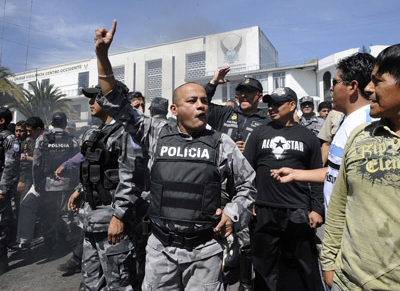
The uprising by putschist elements of the Ecuadoran police against President Rafael Correa confirms an alarming report about the infiltration of the Ecuadoran police by U.S. intelligence services released in 2008, which indicated that many members of the police corps developed a “dependency” on the U.S. Embassy.

JPEG - 100.8 kbRebellious elements within Ecuadorian police seize Quito International Airport, 30 September 2010.
“I applied and was accepted at the Escuela superior de policía de Quito, and studied there from September 1992 to August 1995.”
Guy Philippe, speaking to 
Peter Hallward about his background prior to leading an armed insurgency that contributed to the removal of Haiti’s elected president, Jean Bertrand Aristide.

The report made clear that the Ecuadoran Police “maintain informal economic dependence on the United States, to pay for informants, training, equipment and operations.”
The systematic use of corruption techniques by the CIA in order to acquire the “goodwill” of police officers was described and denounced on many occasions by the ex-CIA agent Philip Ageewho, before leaving the agency’s ranks, was assigned to the U.S. Embassy in Quito.
In his official report, distributed at the end of October 2008, theEcuadoran Defense Minister Javier Ponce revealed how U.S. diplomats dedicated themselves to the corruption of the police as well as officers from the armed forces.
In confirmation, the leadership of the Ecuadoran police then announced that it would sanction any of its agents who collaborated with the United States, while the U.S. Embassy claimed “transparency” in its support of Ecuador.
JPEG - 38.4 kb
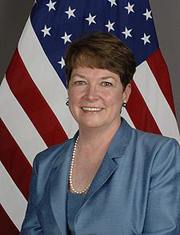
Heather M. Hodges, U.S. Ambassador to Ecuador since January 2008.
“We work with the Ecuadorangovernment, with the military, with the Police, on objectives that are very important for security,” said the U.S. Ambassador in Quito, Heather Hodges.
However, the diplomat told journalists that she would not comment “on intelligence matters.”
For her part, the public affairs officer, Marta Youth, categorically refused to comment on theEcuadoran government’s denunciations, which included complaints about CIA participation in an operation with Colombia that led to a military attack by the Colombian military against FARC guerrillas on Ecuadoran territory on March 1st of that year.
The head of Army intelligence, Mario Pazmiño, had been removed for concealing information related to the attack on the FARC.
In recent months, U.S. officials have appeared in Ecuador under the pretext of extending relations between Ecuador and the United States. Arturo Valenzuela, the U.S. Assistant Secretary of State for Western Hemisphere Affairs, repeatedly visited President Correa, leading up to a visit from Secretary of State Hillary Clinton.
Valenzuela was accompanied by Todd Stern, “Climate Change Envoy,” also known for his CIA ties.


Source: http://www.voltairenet.org/article167150.html

Friday, October 1, 2010

Ecuador's Correa haunted by Honduras


This was a coup attempt – encouraged by Washington's shameful support for the overthrow of Manuel Zelaya last year


by Mark Weisbrot
guardian.co.uk, Friday 1 October 2010 21.13 BST


Ecuador President Rafael Correa
Ecuador's president, Rafael Correa (with microphone), addresses his supporters from the balcony of the government palace in Quito after the coup attempt. Photograph: Pato Realpe/EPA

In June of last year, when the Honduran military overthrew the social-democratic government of Manuel Zelaya, President Rafael Correa of Ecuador took it personally. "We have intelligence reports that say that after Zelaya, I'm next," said Correa.
On Thursday, it turned out to be true. Some analysts are still insisting that what happened was just a police protest over possible benefit cuts that got out of hand. But to anyone who watched the prolonged, pitched gun-battle on TV last night, when the armed forces finally rescued President Correa from the hospital where he was trapped by the police, this did not look like a protest. It was an attempt to overthrow the government.
The co-ordinated actions in various cities, the takeover of Quito's airport by a section of the armed forces – all this indicated a planned coup attempt. And although it failed, at various points during the day it was not so clear what the outcome would be.
The government pointed a finger at a former president and army colonel, Lucio Gutierrez, and he was on television yesterday calling for the ousting of Correa. He accused the president of everything from supporting the Farc (the guerilla group fighting Colombia's government), to wrecking the economy.
The coup might have had a chance if Correa were not so popular. Despite his enemies in high places, the president's approval rating was 67% in Quito a couple of weeks ago. His government has doubledspending on healthcare (pdf), significantly increased other social spending, and successfully defaulted on $3.2bn of foreign debt that was found to be illegitimately contracted. Ecuador's economy managed to squeak through 2009 without a recession, and is projected to grow about 2.5% this year. Correa, an economist, has had to use heterodox and creative methods to keep the economy growing in the face of external shocks because the country does not have its own currency. (Ecuador adopted the dollar in 2000, which means that it can do little in the way of monetary policy and has no control over its exchange rate.)
Correa had warned that he might try to temporarily dissolve the congress in order to break an impasse in the legislature, something that he has the right to request under the new constitution – though it would have to be approved by the constitutional court. This probably gave the pro-coup forces something they saw as a pretext. It is reminiscent of the coup in Honduras, when Zelaya's support for a non-binding referendum on a constituent assembly was falsely reported by the media – both Honduran and international – as a bid to extend his presidency.
Media manipulation has a big role in Ecuador, too, with most of the media controlled by rightwing interests opposed to the government. This has helped build a base of people – analogous to those who get all of their information from Fox News in the United States, but proportionately larger – who believe that Correa is a dictator trying to turn his country into a clone of communist Cuba.
The US state department issued a two-sentence statement from secretary of state Hillary Clinton, who late Thursday urged "all Ecuadoreans to come together and to work within the framework of Ecuador's democratic institutions to reach a rapid and peaceful restoration of order." Unlike the White House statement in response to the Honduran coup last year, it also expressed "full support" for the elected president. This is an improvement, although it is unlikely that it reflects a change in Washington's policy toward Latin America.
The Obama administration did everything it could to support the coup government in Honduras last year, and, in fact, is still trying to convince the South American governments – including Ecuador, Brazil, Argentina and the collective organisation of UNASUR – to recognise the government there. South America refuses to recognise the Lobo government because it was elected under a dictatorship that did not allow for a free or fair contest. The rest of the hemisphere also wants some guarantees that would stop the killing of journalists and political activists there, which has continued and even got worse under the "elected" government.
As the South American governments feared, Washington's support for the coup government in Honduras over the last year has encouraged and increased the likelihood of rightwing coups against democratic left governments in the region. This attempt in Ecuador has failed, but there will be likely be more threats in the months and years ahead.


Source: http://www.guardian.co.uk/commentisfree/cifamerica/2010/oct/01/rafael-correa-ecuador-coup?showallcomments=true#end-of-comments


The battle for Ecuador

Behind this week's police revolt against Rafael Correa, broader, more sinister geopolitical forces are at work
by Mike González


Images of Ecuador's president snatched by police and held hostage in hospital have made news across the world. Ostensibly this was a protest by officers following an announcement of measures to equalise pay and bonuses. But behind the flaming tyres and tear gas attacks is a more sinister story.
Rafael Correa, Ecuador's president, is seen as one of the group of radical, reforming leaders linked to Hugo Chávez of Venezuela and Evo Morales of Bolivia. He has challenged landed interests in Ecuador and the business sector in Guayaquil, whose hostility to his government has been palpable. His proposed reforms included modernisation of agriculture and a recognition of the country's multi-ethnic character – enshrined in a new constitution.
Ecuador's export earnings, including oil revenues, rarely reached its poor communities. It was Correa's promise to direct national resources to the majority, strengthen the public sector and diversify the economy that won him the support of the electorate. And his reputation was enhanced by his refusal to renew the lease on the US military base at Manta and the decision to suspend the repayment of its foreign debt.
Yet recent decisions have suggested there are limits to this reform. Correa has negotiated new contracts with foreign oil and mining companies that have met determined resistance from indigenous communities whose land and water rights were directly threatened.
More significantly, they were signs that Ecuador would continue to depend on its extractive industries and on the global market from which it had tried to escape. Thus organisations which had opposed Ecuador's integration into the global market, and dismissed three presidents in the process, are again fighting government in defence of communal rights and an economic future based on production for the domestic market, and economic as well as political democracy.
And there are broader forces at work. Ecuador's two neighbours, Colombia and Peru, are close allies of the US and defenders of neo-liberal policies which have brought them into bitter conflict with their own majority populations. Their declarations of support for Correa ring less than true bearing in mind that the previous Colombian government, under Álvaro Uribe, entered Ecuador in pursuit of guerrilla leaders and in defiance of international law. A declaration to build further US military bases in Colombia was both a direct reaction to Correa's decision to close down Manta and a confirmation of Colombia's key role in US plans for the region.
The brief insurrection in Ecuador echoes last year's military coup in Honduras, when a president sympathetic to Bolivia and Venezuela was dragged from his bed and expelled from the country. Then, as now, there was a lengthy silence from Washington until the secretary of state, Hillary Clinton, offered to "mediate" between the leaders of an illegal coup and a democratically elected president. Today the leaders of the coup remain in power with US support despite a mass movement that has persisted through repression and violence.
It may well be that Ecuador's previous president, Lucio Gutiérrez, hopes to gain from a similar "mediation".
Rafael Correa's defiant speech from the balcony of his hospital room will have won him admiration from his supporters. As the Confederation of Indian Nations of Ecuador declared, the right is only interested in pulling back the gains that have been made by the people of Ecuador. But, they continue, any attempt to reconcile the coup-plotters will have the same effect.
It is now more important than ever to continue and deepen the battle for the transformation of Ecuador, whoever leads that struggle.


Police Mutiny Threatens Democracy


By Gonzalo Ortiz


QUITO, Sep 30, 2010 (IPS) - With the backing of large crowds of supporters in the streets and of statements from presidents throughout Latin America, the Ecuadorian government of Rafael Correa is attempting to quell a riot by hundreds of police protesting a cut in their benefits which has thrown the country into chaos.

As soon as news reports on the crisis in Ecuador began to came out, statements of support for Correa started to roll in, from the governments of Argentina, Chile, Bolivia, Brazil, Colombia, Paraguay, Peru, Uruguay and others.

The Organisation of American States (OAS) Permanent Council immediately called an emergency meeting, and expressed its "repudiation of any attempt to alter the democratic institutional system" in Ecuador, and also its "firm" support for the constitutional government.

U.S. Secretary of State Hillary Clinton said in a statement: "We are closely following events in Ecuador. The United States deplores violence and lawlessness and we express our full support for President Rafael Correa, and the institutions of democratic government in that country.

"We urge all Ecuadorians to come together and to work within the framework of Ecuador's democratic institutions to reach a rapid and peaceful restoration of order."

Venezuelan President Hugo Chavez and other regional leaders are on their way to Buenos Aires for an emergency summit of the Union of South American Nations.

The national police began to protest Thursday, demanding the repeal of a public services law approved by the legislature Wednesday that would end the practice of granting soldiers and police medals and bonuses with each promotion, and would extend from five to seven years the period between promotions.

The situation has rapidly spiralled out of control. The president is under the protection of the highest police authorities in the police hospital, where he was taken after the first incidents broke out at a police station on the north side of Quito. But the hospital remains surrounded by police protesters.

In the meantime, the Plaza de la Independencia in front of the seat of government has filled up with Correa's supporters.

In the face of the chaos caused by the police riot, the government declared a state of emergency "to guarantee the protection of citizens," minister of internal security Miguel Carvajal reported.

The government also ordered all radio and TV stations to carry an uninterrupted national broadcast.

The airport was shut down by the air force, and all incoming and outgoing flights have been cancelled. The public TV station reported that this shows that not only the police are involved, but that the movement has also had ramifications in the armed forces.

From the balcony of the presidential palace, foreign minister Ricardo Patiño urged Ecuadorians to "peacefully and courageously take to the main streets of the cities to express your support for the government and oppose the coup d'etat."

He also asked the crowd in the square outside the seat of government to march to the police hospital and "rescue the president."

Patiño and several other ministers who addressed Correa's supporters also instructed some groups of demonstrators to stay in the plaza to safeguard the presidential palace.

Alexandra Ocles, government secretary of social movements and citizen participation, said groups of supporters were on their way to Quito from the provinces to help protect democracy.

The uprising that began in the early hours of the morning caused an unprecedented lack of police patrols in the streets, traffic problems, a suspension of classes in schools, and the closure of airports. The public radio station reported looting in Guayaquil and bank robberies in Quito and other cities.

Shortly after the crisis broke out, banks and businesses shuttered their doors to avoid problems.

The rioters hunkered down in their police stations behind armoured vehicles, while family members and sympathisers burnt tires around the buildings.

"We have to stop the coup"

Simón Pachano, director of the political studies programme at the Latin American Faculty of Social Sciences (FLACSO), described the situation as "extremely complicated." In an interview with IPS, he said the president "did not leave any alternative but the use of force" and that he "put his head in the lion's mouth" by visiting a police station Thursday morning, where things grew tense.

Economist Alberto Acosta, who was president of the constituent assembly that rewrote the constitution in 2008 but is now distanced from Correa, told IPS that "this is an attempted coup, and it has to be stopped.

"There are forces that are taking advantage of the situation," he maintained.

"The demands set forth by the members of the police and the armed forces might be justified, but this is not the right way. They can't use weapons to demand labour conditions," Acosta said.

"What must be defended are democracy and the constitution, although that does not mean we should put up with the president's domineering," he added.

Pachano, however, does not see what is happening as a coup. "This wasn't planned," he argued.

He predicted, instead, that Correa might dissolve the legislature, under a provision laid out in the constitution.

"Correa would thus have a long time to run the country however he wished, if he manages to get the security forces under control, because the constitution requires that all parties go through the registration process anew, which means it would be many months before new elections could be held," he said.

"Kill me if you want"

On Thursday morning, Correa went to the Regimiento Quito, one of the main police stations in Quito, to try to persuade the protesters in person, addressing them from a second-floor balcony. He argued that he had increased their wages, which was why the bonuses were being cut.

The police gathered below the balcony shouted back that it was not true, that their wages had been increased by former President Lucio Gutiérrez (2003-2005), which angered Correa, who began to argue with the protesters.

Correa repeated several times that the law would not be repealed. "Not one step backwards," he said over and over again.

This further angered the police, and when the president attempted to leave, some of the protesters doused him with water and threw objects at him.

Correa then challenged them: "Here I am, kill me if you want."

Two tear gas canisters then exploded, while the presidential guard (which depends on the army) removed him from the police station and bundled him off to the police hospital nearby.

He was taken there with difficulty because he is on crutches after undergoing knee replacement surgery on Sept. 20.

In an interview later with the public radio station, the president said he was on a drip.

He also said the hospital was surrounded by police and that police officers were trying to get into his room, over the roof and from the hallways, to kidnap him.

In the interview, he emphasised that he had significantly raised police and military salaries since taking office in 2007, and accused the opposition of plotting a coup and taking advantage of the misinformation spread among the armed forces and the police.

In remarks from Cuenca, 400 km south of Quito, the head of the armed forces, General Luis Ernesto González, said the military backed the government and that it was "on alert to protect the security of the country" and would intervene if necessary, after evaluating the situation.

Members of the police who appeared with facemasks or with their backs to the cameras on several TV stations insisted that they would only call off their protests when the law was overturned.

The public services law, whose original version was introduced to Congress by the government in August, was discussed in two debates and slightly modified by the legislature. But Correa vetoed four of its provisions and sent it back to Congress, which finally passed it on Wednesday, approving three of the president's four vetoes. (END)


Source: http://ipsnews.net/news.asp?idnews=53023

Report from Ecuador: Democracy Under Threat

Written by Jennifer Moore   
Friday, 01 October 2010 08:05
Correa during teargas attack

Correa during teargas attack (AFP


Faced with an apparent attempt to oust Ecuadorian President Rafael Correa on Thursday, Ecuador received an outpouring of support from Honduras to the White House. Most Ecuadorian social organizations, many of whom have had serious differences with the Andean president in recent years, also condemned threats on the country's democratic and constitutional order.
Early Thursday, Ecuador awoke to police protests across at least six highland and coastal cities. Police burned tires, shut down a main bridge in the economic centre of Guayaquil, and neglected their posts giving way to some looting and robberies before midday. The police said they were protesting the Public Security Law passed Wednesday night, which they claim will retract certain economic benefits from the armed forces such as bonuses and medals.
When President Rafael Correa personally confronted police protesting at the First Regiment in the nation's capital of Quito, police responded with tear gas. The President, who recently underwent knee surgery, fell and was carried into the police hospital.
Police who had been protesting started returning to work in other parts of the country by early afternoon, but tension continued in the capital while Correa remained in hospital.  State media dominated the airwaves, accusing the country's right wing of an attempted coup and alleging involvement of the opposition Patriotic Society Party and the influence of ex-President Lucio Gutierrez who was overthrown in a popular ouster in April 2005. Correa reported that police told him he would not escape from his hospital room if he did not revoke the Public Security Law.
Popular mobilizations in support of the President grew throughout the afternoon and into the evening, with the political crisis persisting until shortly before 10 pm when a five hundred and fifty strong military and police operation returned the President to the government palace. One special forces officer was reported to have been killed in the operation and several others wounded.
Outpouring of international support
With the military-backed elite ouster of President Manuel Zelaya from Honduras in June 2009 still fresh in recent memory in Latin America, the democratically-elected President Correa received a quick outpouring of international support.
Honduran social organizations still reeling from the 2009 coup were among the earliest to send their messages of solidarity. Targeted assassinations and threats against social movements in the largest of Central American countries continue to be denounced on a monthly basis, the country has also become one of the most dangerous worldwide for journalists, and has yet to be reemitted into the Organizations of American States (OAS).
Latin American, European and North American governments also expressed support for the maintenance of democratic order in Ecuador. The OAS “repudiated” any attempt against the Correa administration and made a call to governments and multilateral institutions in the region to "stop the coup d'etat from becoming a reality," urging them to act "in a unanimous way.” Statements were also released by the US Department of State and later in the day by Canada's Department of Foreign Affairs, which remain important trade and investment partners for the oil-dependent Andean nation. The US urged Ecuadorians “to work within the framework of Ecuador’s democratic institutions to reach a rapid and peaceful restoration of order," whereas Canada said that "it is concerned about growing unrest" and reiterated "support for the democratically elected government of the Republic of Ecuador."
Indigenous oppose coup and call for greater democracy
Although indigenous and other social organizations in Ecuador have been in conflict with the Correa administration for the last few years, important groups such as the Confederation of Indigeous Nationalities of Ecuador (CONAIE) and ECUARUNARI, the large highland affiliate of the CONAIE, made strong statements condemning all threats on Ecuadorian democracy.
The CONAIE and ECUARUNARI have led regular protests against various policy reforms taking place under the Correa government during the last year, for which their leaders have recently faced terrorist charges. At the local level, indigenous and non-indigenous communities protesting mining and oil expansion have also faced repeated repression and recent criminalization. Despite, however, calls from at least one political representative of the indigenous Pachakutik party to support opposition to the Correa government, these organizations maintained a firm stance in defense of democracy. 
The CONAIE blamed Correa's lack of openness to dialogue concerning current reforms and his failure to build strong alliances with Ecuadorian social movements as a source of vulnerability to attempts from the right to destabilize his government. “While the government has dedicated itself exclusively to attacking and delegitimizing organized sectors like the indigenous movement, workers' unions, etc.,” the CONAIE observed, “it hasn't weakened in the least the structures of power of the right, or those within the state apparatus.”
The CONAIE also credited the most reactionary right wing elements in the country with backing Correa's ouster, anticipating that the policitical crisis could be used to legitimate right wing tendencies “from inside and outside the government... to justify their total alliance with the most reactionary sectors and with emerging business interests.” While stating their opposition to Correa's support for expansion of oil and metal mining extraction and agro-industry interests, they energetically rejected this “disguised right wing support” for the attempted coup, saying they “ will continue to struggle for the construction of a plurinational state with a true democracy.”
ECUARUNARI also released its own statement blaming the right and imperialist interests with trying to organize Correa's ouster in reaction to the country's Political Constitution which was passed overwhelmingly in September 2008. The new constitution recognizes the human right to water, rights for nature, and Ecuador as a plurinational state. While ECUARUNARI held the Correa government responsible for making concessions to multinational corporations that “leaves those reactionary sectors free to act in this way,” they affirmed their opposition to  the coup attempt and put member organizations on alert to defend “the plurinational state.”
While Correa is likely to come out of Thursday's political crisis in a strengthened position to continue legal reforms that have been centralizing power and leading to conflict with important social sectors, the Regional Advisory Group on Human Rights in Quito suggested that the crisis could be an opportunity for Correa to renew support for social groups that helped get him first elected in November 2006. In a written statement, they said, “we call upon the national government to set aside its arrogant attitude that is isolating it from the social bases. Together,” they continued, “we can build a country with dignity, peace and sovereignty, in which dialogue with social sectors is a daily activity that guides our path toward a country distanced from extractive policies and dependence on a development model based on the destruction of nature.”
Source: http://upsidedownworld.org/main/component/content/article/2720-report-from-ecuador-democracy-under-threat-